 Apparel Boxes
 Soap Boxes
 Candle Boxes
 Bakery Boxes
 Cosmetic Boxes
 Cardboard Boxes
 Vape Boxes
 Pillow Boxes
 CBD Boxes
 Cigarette Boxes
 Hair Extension Boxes
 Retail Boxes
 Hemp Boxes
 Display Boxes
 Jewelry Boxes
 Food Boxes
 Die Cut Boxes
 Toy Boxes
 Window Boxes
 Corrugated Boxes
 Kraft Boxes
 Rigid Boxes
 Mailer Boxes
 Mylar Bags
 Gift Boxes
 Seasonal Boxes
 Custom Labels
 Custom Sticker
 Sport Boxes
 Foldable Boxes
 Gable Boxes
 Insert Boxes
 Sleeve Boxes
 Tuck Boxes
 Tin Packaging
 Tube Packaging
 Small Boxes


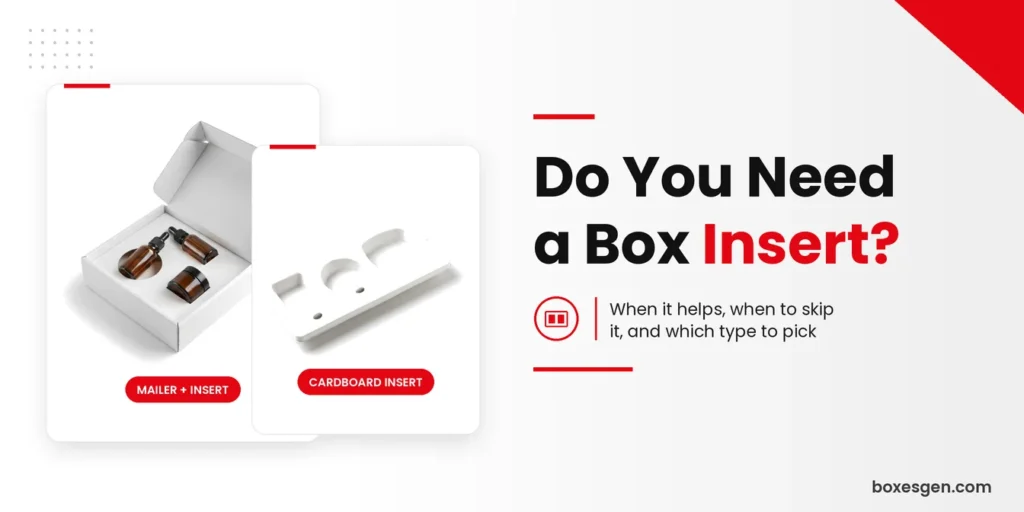
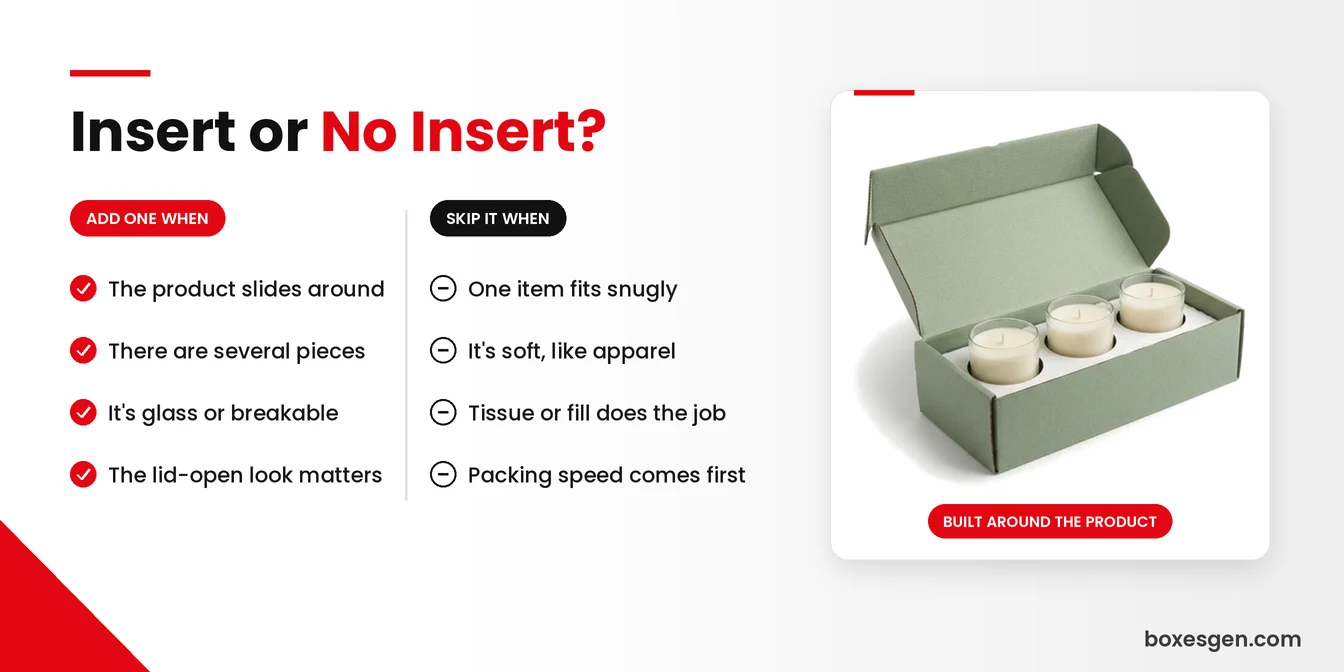
You need an insert when your product can slide around in the box, when a set has several pieces that knock into each other, when something is glass or easy to chip, or when the moment the lid opens is part of what you’re selling. If you ship one soft item that already fits the box snugly, you can usually skip it and save a step at the packing table.
That’s the short answer. The longer one depends on what’s going in the box, how it travels and how much time your team has to pack each order. Below is how we think about it when a customer asks us whether an insert is worth adding.
When an insert earns its place
The most common reason is movement. A jar or bottle sitting loose in a mailer box will hit the walls every time a carrier tosses the parcel. An insert with a cavity cut to the product’s shape keeps it in one spot, so the product and the print on the box both arrive looking the way you planned.
Sets are the second big reason. A skincare kit with a serum, a cream and a small tool looks tidy when each piece has its own pocket. Without one, the customer opens the box to a jumble at one end. The same goes for candle trios, coffee samplers and gift sets with a card on top.
Breakable items are the third. Glass, ceramic and anything with a pump or dropper top does better when it can’t move and can’t touch the item next to it.
And then there’s presentation. If you’re paying for a printed box, the insert is what makes the first look feel arranged instead of packed. For some brands that’s the whole point of the box.
When you can skip it
Not every order needs one. A t-shirt folded in tissue, a single item that fills most of the box, or a product that’s soft and won’t break are all fine without an insert. Crinkle paper or tissue does the job for a lot of apparel and accessory brands.
Packing speed matters too. Every insert is one more piece to fold and place. If you ship a few hundred orders a day by hand, ask yourself whether the extra seconds per box are worth it for that product. Sometimes a well-sized box is the better fix. Our guide on how to measure a box for shipping walks through getting that size right.
The main types of box inserts
Most custom box inserts fall into a few groups. Which one fits depends on the weight of your product, how exact the fit needs to be and whether you want the whole package to stay paper-based.
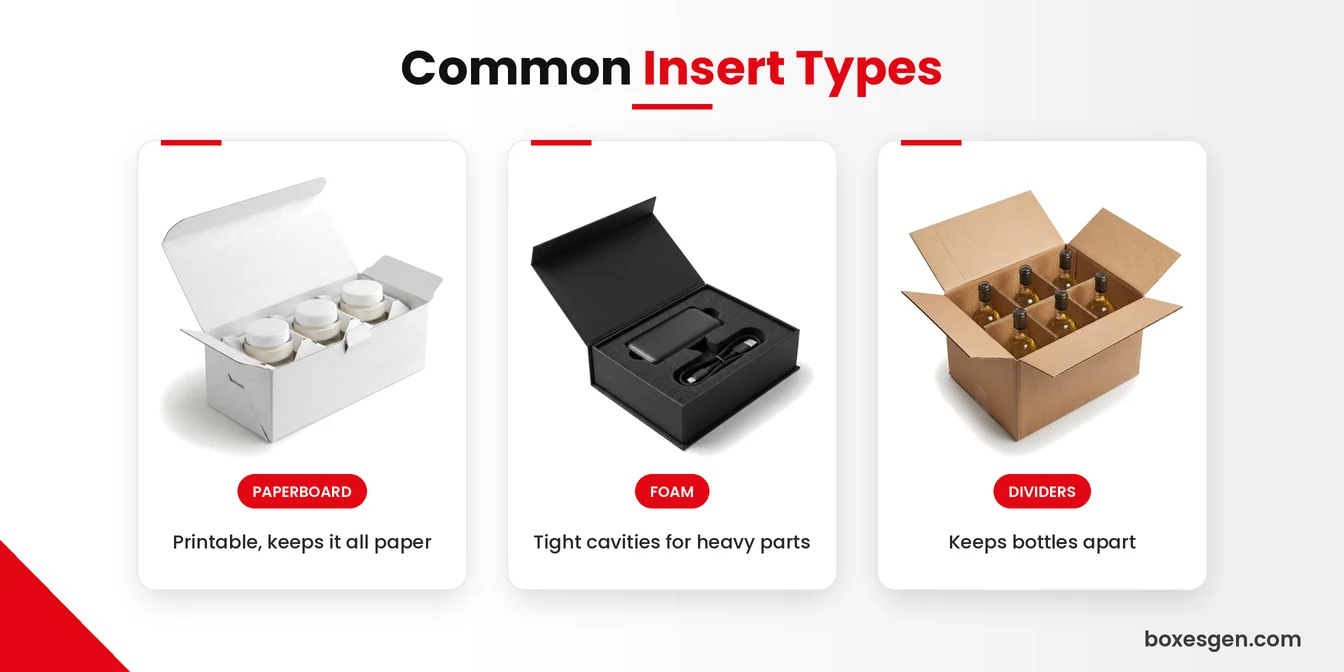
Paperboard die-cut inserts. A flat sheet cut and folded into a tray with holes or pockets. Good for lighter items like cosmetics, small bottles and accessories. It can be printed, and the whole box stays paper. See our cardboard inserts for examples.
Corrugated inserts and dividers. Thicker and stiffer, so they hold heavier items and keep bottles apart. Dividers are the simple version: walls that split the box into cells. Browse box dividers if that’s closer to what you need.
Foam inserts. Cut to tight cavities, often used for tools, electronics, devices and anything heavy or high value. Foam grips well, but it means the package is no longer all paper, which matters if you market your packaging as recyclable. Our EVA foam inserts show the style.
Inserts built into a mailer or rigid box. Many customers order the box and insert together so they’re sized as one unit. Take a look at printed boxes with inserts or the wider insert boxes range.
| Insert type | Works well for | Keep in mind |
|---|---|---|
| Paperboard die-cut | Cosmetics, small bottles, accessories, gift sets | Best for lighter items |
| Corrugated insert or dividers | Heavier bottles, jars, multi-item kits | Takes up a bit more room in the box |
| Foam | Tools, electronics, heavy or high-value parts | Not all paper, so check your recycling message |
| Built into the box | Subscription boxes, PR kits, product launches | Box and insert are planned together |
Not sure which one suits your product? Send us your product details for a free quote and our team can suggest a type.
What we need from you so it fits
Insert problems almost always come down to measurements. The insert is cut to your product, so small gaps in the numbers show up as a loose fit or a cavity that’s too tight to get the product into.
- The exact length, width and height of every item, including caps, pumps, droppers and lids. A pump top can add more height than people expect.
- How you’d like the items laid out: side by side, standing up, lying down, or with a card on top.
- Whether the insert should be printed or plain.
- If you can, a sample of the product. It’s the surest way to get the fit right.
A few things we keep an eye on during production. A cavity cut to the exact size can be hard to get the product into, so a little room usually helps. A small finger notch next to a pocket makes it easy for the customer to lift the item out. And if your bottle or jar supplier changes, check the new size before you reorder, because even a few millimeters can change the fit.
The box size usually comes after the insert. Once the insert layout is settled, the box is sized around it, not the other way around. That’s also why it helps to bring all your details in one go. Our custom box quote checklist covers what to send, and these common ordering mistakes are worth a read before you place an order.
Printing on the insert
An insert doesn’t have to be plain. A printed insert can carry a short thank-you line, a logo, or simple directions for using the products in a set. It’s the first thing the customer sees after the lid, so it’s a good spot for a small message. If you want the box itself to do more of that work, our comparison of mailer boxes and tuck end boxes explains which styles show off an insert best.
How BoxesGen helps
We make custom printed boxes and inserts with a low minimum order, so you can start small and adjust the fit on your next run. Turnaround depends on the delivery package you choose, with the fastest package at 2 to 4 business days, and shipping within the US is free. If you’re unsure which insert to go with, our team can look at your product and suggest one.
Get a free quote for your custom box and insert.
FAQ
Can a box insert be printed?
Usually, yes. Paperboard and corrugated inserts can be printed with a logo, a message or instructions. Foam is normally left plain.
Can I add an insert to a mailer box?
Yes. Mailer boxes with inserts are one of the most common setups, especially for subscription boxes, kits and PR packages.
Does adding an insert change the box size?
It can. The box is sized around the insert and the products in it, so the outer size may end up a little larger than the product alone.
Foam or cardboard insert: which should I pick?
Cardboard suits lighter items and keeps the packaging all paper. Foam holds heavy or delicate items very tightly but isn’t paper, so it depends on the product and your recycling message.
What should I send to get an insert quoted?
The exact size of each item, how you’d like them arranged, whether the insert is printed, and the quantity you need. A product sample helps most.
By BoxesGen Packaging Team
 Facebook
 Twitter
 LinkedIn
 Pinterest