
 Apparel Boxes
 Soap Boxes
 Candle Boxes
 Bakery Boxes
 Cosmetic Boxes
 Cardboard Boxes
 Vape Boxes
 Pillow Boxes
 CBD Boxes
 Cigarette Boxes
 Hair Extension Boxes
 Retail Boxes
 Hemp Boxes
 Display Boxes
 Jewelry Boxes
 Food Boxes
 Die Cut Boxes
 Toy Boxes
 Window Boxes
 Corrugated Boxes
 Kraft Boxes
 Rigid Boxes
 Mailer Boxes
 Mylar Bags
 Gift Boxes
 Seasonal Boxes
 Custom Labels
 Custom Sticker
 Sport Boxes
 Foldable Boxes
 Gable Boxes
 Insert Boxes
 Sleeve Boxes
 Tuck Boxes
 Tin Packaging
 Tube Packaging
 Small Boxes

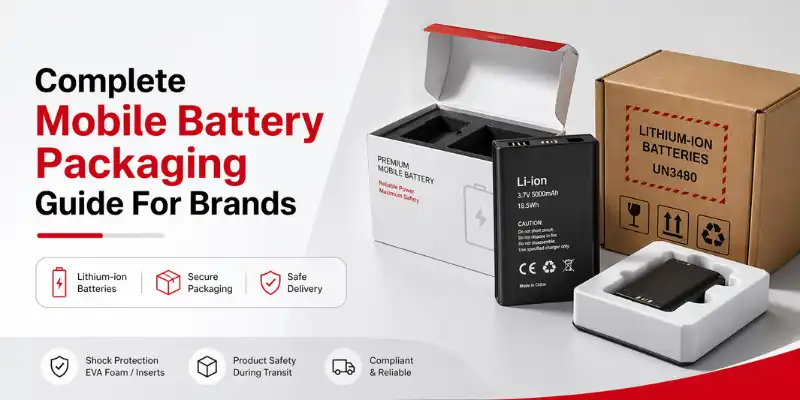
If you sell mobile batteries or power banks in the United States — whether through Amazon, Walmart shelves, or your own e-commerce store — your packaging is doing more work than you think. It is protecting a regulated product, satisfying federal safety requirements, convincing a shopper to pick your product over the one next to it, and representing your brand the moment a customer opens their order.
This guide covers everything your brand needs to know about mobile battery packaging: materials, types, DOT and IATA compliance, design strategy, eco-friendly options, and how to choose between custom and stock solutions. It is written for battery brands, private-label sellers, and electronics retailers who want practical, actionable information — not a sales pitch.
What Is Mobile Battery Packaging?
Mobile battery packaging refers to the specialized boxes, inserts, blister cards, and protective materials used to store, protect, transport, and present lithium-ion and lithium-polymer battery products at retail or through e-commerce channels.
The category includes packaging for:
- Replacement smartphone and tablet batteries (Android and iOS)
- Portable power banks and wireless charging pads
- USB-C and Lightning charging cables and adapter kits
- Battery-integrated phone cases
- High-capacity lithium packs for rugged or industrial mobile devices
What separates mobile battery packaging from standard consumer goods packaging is the added layer of compliance responsibility. Lithium-ion and lithium-polymer cells are classified as regulated dangerous goods under US and international law. Your packaging must protect the product, meet safety and shipping regulations, and present your brand effectively — all at the same time.
Why Mobile Battery Packaging Is More Complex Than Most Categories
Lithium Batteries Are Regulated Dangerous Goods
Under US Department of Transportation regulations (49 CFR Parts 171–180) and IATA Dangerous Goods Regulations for air transport, lithium-ion and lithium-polymer batteries are classified as dangerous goods. This is because lithium cells, when improperly packaged or damaged, can experience thermal runaway — a chemical chain reaction that generates extreme heat and, in serious cases, fire.
As a result, mobile battery packaging must comply with specific rules around:
- Terminal protection to prevent short circuits
- Inner packaging that prevents movement and contact between cells
- Outer packaging that meets specific drop and compression performance standards
- Watt-hour limits per package for air shipment
- Mandatory warning labeling including the UN lithium battery mark
These are not optional guidelines. They are enforceable federal and international regulations that apply to every brand shipping lithium batteries commercially in or from the United States.
Packaging Directly Influences Purchase Decisions
In consumer electronics accessories, a large share of purchase decisions happen at or near the point of sale — where the packaging is often the only information a customer has about your product. A mobile battery box that clearly communicates device compatibility, capacity, safety certifications, and brand identity gives buyers the confidence to complete the purchase. Packaging that looks generic or unclear raises questions about quality and legitimacy — a serious problem in a category where counterfeit and substandard batteries are a documented consumer safety concern.
E-Commerce Packaging Affects Reviews and Repeat Business
For brands selling mobile batteries online, the box a customer receives is their first physical interaction with your brand. Packaging that arrives undamaged, organized, and well-presented creates a positive impression that influences post-purchase reviews and repeat orders. Packaging that arrives crushed, disorganized, or visually underwhelming does the opposite — and in an era of public reviews and social sharing, that impression spreads.
Types of Mobile Battery Packaging
1. Retail Blister Card Packaging
A blister card consists of a formed plastic cavity heat-sealed or folded onto a printed paperboard backer card. The battery sits in the plastic blister, fully visible to the shopper, while the printed card displays brand information, device compatibility, safety warnings, and regulatory text.
Best for: Pharmacy retail, convenience stores, impulse-purchase locations, and hook display at point of sale. High product visibility without requiring the shopper to open anything.
2. Custom Folding Carton Box
A folding carton — also called a tuck-end box or retail carton — is the most versatile mobile battery packaging format. It provides full printable surface area on all six panels for brand graphics, product specifications, compatibility information, safety data, and barcodes.
Folding cartons for mobile batteries range from simple single-color kraft boxes for budget products to full-color boxes with premium lamination, spot UV coating, and embossed logos for mid-range and premium brands. Window die-cuts can show the battery inside without opening the package.
Best for: Most retail and e-commerce battery products. The most common format across the category.
3. Rigid Gift Box
High-end power banks, wireless charging sets, and premium battery bundles are increasingly packaged in rigid boxes — thick, non-folding chipboard structures covered in printed or textured paper. Rigid mobile battery packaging typically features magnetic or ribbon closures and custom foam or cardboard inserts that present each component in a designated position.
Best for: Gift-occasion products, corporate gifting programs, and premium accessories where the packaging itself is part of the value proposition.
4. Corrugated Shipping Box
For brands shipping mobile batteries directly to consumers, a corrugated outer box provides the structural protection required to survive standard carrier handling. Single-wall or double-wall corrugated construction is selected based on battery weight, shipment distance, and required drop and compression performance.
For lithium battery shipments, corrugated outer packaging must meet the physical performance standards outlined in IATA Packing Instructions 965–970, depending on battery type and watt-hour rating.
Best for: E-commerce DTC shipments, wholesale, and B2B distribution.
5. Mailer Box
Self-locking corrugated mailer boxes are a popular choice for DTC battery brands focused on the unboxing experience. Custom-printed interior surfaces, foam or cardboard inserts, and branded tissue paper can transform a standard mailer box into a memorable brand moment without the cost of a rigid box.
Best for: Subscription brands, premium DTC battery products, and brands investing in unboxing content.
6. Anti-Static Protective Pouch
Bare lithium battery cells sold to repair technicians, wholesale buyers, and professional installers are commonly packaged in anti-static polyethylene pouches combined with a printed header card or small outer carton. Anti-static packaging prevents electrostatic discharge from damaging sensitive battery circuitry.
Best for: Professional distribution channels, wholesale, and B2B technical battery sales.
Materials Used in Mobile Battery Packaging
| Material | Properties | Best Use |
|---|---|---|
| 14–24pt Cardstock | Excellent printability, clean folds, recyclable, FSC-certified options available | Retail folding cartons for lightweight battery products |
| Corrugated Board (E-flute) | Impact cushioning, compression resistance, thinner profile than B/C-flute | E-commerce shipping boxes, DTC outer packaging |
| Rigid Chipboard (2–3mm) | Dense, premium feel, wrapped in printed or textured material | Gift boxes, premium power bank packaging |
| Natural Kraft Paper | Unbleached, recyclable, biodegradable, accepts 1–4 color print | Eco-positioned brands, mailers, sustainable retail cartons |
| Anti-Static Polyethylene | Dissipates electrostatic charge, protects circuit integrity | Bare lithium cells, professional/technical battery distribution |
Regulatory and Safety Requirements for Mobile Battery Packaging
This section targets searches like “lithium battery packaging requirements USA”, “49 CFR battery packaging”, “IATA packing instructions lithium batteries”
DOT and IATA Lithium Battery Regulations
In the United States, lithium batteries are regulated under 49 CFR (Pipeline and Hazardous Materials Safety Administration regulations) for ground transport and under IATA Dangerous Goods Regulations for air shipment. The specific packing instruction that applies to your shipment depends on:
- Battery chemistry: lithium-ion (rechargeable) vs. lithium metal (non-rechargeable)
- Watt-hour rating per cell and per package
- Whether batteries are shipped alone or installed/packed with equipment
- Whether the shipment is domestic ground, domestic air, or international air
Key packaging requirements under these frameworks include:
- Individual terminal protection for each cell or battery to prevent short circuits
- Inner packaging that prevents movement and contact between cells
- Outer packaging meeting specific drop height and compression load test standards
- Watt-hour-based quantity limits per outer package for air shipment
Carriers including FedEx, UPS, and USPS each publish their own lithium battery acceptance policies that build on the base regulatory requirements. Brands shipping mobile batteries commercially are responsible for understanding which packing instructions apply to their specific products.
Required Labeling on Mobile Battery Packaging
Regulatory labeling requirements for mobile battery packaging include:
- UN lithium battery mark: UN3481 (lithium-ion batteries packed with equipment) or UN3480 (lithium-ion batteries shipped alone)
- Watt-hour rating clearly stated on the outer package
- Country of origin
- Manufacturer name and contact information
- Lithium battery handling label for packages meeting air shipment thresholds
Professional mobile battery packaging typically also displays: battery capacity in mAh, output voltage, compatible device categories, warranty terms, CE / FCC / RoHS / UL certification marks, and recycling and disposal instructions consistent with EPA guidance.
Child Safety Considerations
Lithium battery cells present an ingestion and burn risk for young children. While consumer battery packaging is not generally required to meet CPSC child-resistant standards in the same way as pharmaceutical packaging, brands selling household consumer batteries are increasingly incorporating tamper-evident seals as both a safety signal and a product integrity measure.
Design Best Practices for Mobile Battery Packaging
Lead With Compatibility — Make It Impossible to Miss
Device compatibility is the first question a battery buyer needs answered: Which phones does this work with? What connector does it use? Packaging that requires a customer to search for this information loses sales. Compatibility information must appear prominently on the front panel of the packaging, in readable type, before any other claim.
Pro Tip: If your battery fits 15+ devices, lead with the top 3–5 most-searched models (e.g., iPhone 15, Samsung Galaxy S24) and add “+ more” with a QR code linking to a full compatibility list.
Display Technical Specs That Build Confidence
Battery capacity in mAh, output voltage, maximum charging wattage, fast-charge protocol (USB Power Delivery, Qualcomm Quick Charge), and rated cycle life are meaningful data points for informed buyers. Displaying these specifications clearly signals that your product is tested and legitimate — which matters in a category where consumers are understandably cautious about quality.
Make Safety Certifications Visible
CE, FCC, RoHS, and UL certification marks provide meaningful purchase reassurance in a market where substandard batteries are a documented concern. Place these marks in a visible location on the front or back of the packaging — not buried in fine print on a flap.
Match Your Surface Finish to Your Brand Position
The finish on a mobile battery box communicates brand positioning before a customer reads a single word:
- Gloss lamination — energetic, value-positioned, high visual impact
- Matte lamination — premium, considered, understated quality
- Spot UV on logo elements — tactile contrast that signals craft and attention to detail
- Soft-touch coating — luxurious feel associated with flagship electronics brands
Finish selection should be a deliberate brand decision, not a default chosen for cost alone.
Eco-Friendly Mobile Battery Packaging Options
Environmental responsibility in packaging is increasingly relevant for battery brands as consumer awareness of packaging waste grows and state-level regulations tighten — particularly in California under SB 54 and in states with extended producer responsibility frameworks.
Practical eco-friendly options compatible with mobile battery packaging requirements:
- FSC-certified recycled paperboard as the primary substrate — no structural compromise
- Natural unbleached kraft for cartons and mailers
- Water-based and soy-based inks in place of solvent-based alternatives
- Biodegradable and compostable lamination coatings
- Molded pulp or cardboard alternatives to plastic blister components where protection requirements allow
Each of these options is compatible with standard commercial printing and finishing processes. Eco-friendly packaging does not require a reduction in quality or visual appeal.
Custom vs. Stock Packaging for Mobile Batteries
Stock packaging — pre-manufactured generic boxes available for immediate purchase — offers speed and low minimum order quantities. For brands testing a new product or operating at very low volumes, stock packaging may be a practical starting point.
Custom mobile battery packaging allows brands to:
- Specify exact dimensions matched to their specific product — no wasted space, no movement inside the box
- Incorporate regulatory labeling directly into the printed design — compliance built in, not stuck on
- Include compatibility and specification information specific to their SKU
- Build a consistent, recognizable brand identity across all packaging materials
- Select materials and finishes that match their channel and price point
At meaningful production volumes (typically 500+ units), custom packaging becomes cost-competitive with stock alternatives on a per-unit basis, while delivering significantly better fit, compliance integration, and brand presentation. The decision ultimately depends on production volume, brand stage, and how central the packaging experience is to your positioning.
Frequently Asked Questions
What packaging is legally required for shipping lithium batteries in the USA?
Under 49 CFR and IATA Dangerous Goods Regulations, lithium batteries must have terminals protected against short circuit, be placed in inner packaging that prevents movement, and be packed in outer packaging meeting specific drop and compression performance standards. The applicable packing instruction depends on battery chemistry, watt-hour rating, and shipment mode. Consult 49 CFR Part 173 or the current IATA DGR for the specific requirements applicable to your product. When in doubt, work with a certified dangerous goods shipping consultant.
What cardstock weight is standard for retail mobile battery packaging?
14pt to 18pt cardstock is the industry standard for retail mobile battery folding cartons. It provides reliable printability, clean fold lines, and adequate structure for lightweight battery products while remaining cost-effective at commercial production volumes. Heavier products or premium positioning may warrant 24pt stock.
Do I need anti-static packaging for mobile batteries?
Anti-static packaging is standard practice for bare lithium cells and is commonly required by professional and wholesale buyers. Retail consumer packaging for batteries in sealed plastic housings generally does not require anti-static materials, though this should be confirmed based on the specific product construction and distribution channel.
What certifications should appear on mobile battery packaging?
At minimum, applicable packaging must display the UN lithium battery mark, watt-hour rating, and country of origin as regulatory requirements. FCC, CE, RoHS, and UL marks are standard safety and compliance signals for retail consumer batteries sold in the US and international markets. Their applicability depends on your specific product and target markets.
Is eco-friendly packaging viable for lithium battery products?
Yes. FSC-certified recycled cardboard, kraft, soy-based inks, and biodegradable coatings are all compatible with mobile battery packaging requirements. The main consideration is ensuring that structural performance — particularly for corrugated shipping boxes — meets the drop and compression standards required for lithium battery transport under 49 CFR and IATA packing instructions.
What is the minimum order quantity for custom mobile battery packaging?
Minimum order quantities for custom folding cartons typically start at 500–1,000 units depending on the supplier, box complexity, and printing method. Digital printing can accommodate lower MOQs (100–500 units) with slightly higher per-unit cost, making it a practical option for brands launching new SKUs or testing market fit before committing to larger offset print runs.
Final Thoughts
Mobile battery packaging involves more moving parts than most product categories. The combination of lithium battery safety regulations, carrier acceptance requirements, retail display standards, and consumer trust factors means that packaging decisions have real consequences for compliance, sales, and brand reputation.
The brands that win in this category treat packaging as a strategic asset — not an afterthought. They lead with compatibility and specs, display certifications prominently, select materials and finishes that reflect their brand position, and ensure every package is fully compliant before it ships.
If you are working through packaging specifications, regulatory labeling requirements, or material selection for a mobile battery product, BoxesGen works with battery brands and electronics retailers across the United States on custom packaging solutions for lithium batteries and related accessories. Our packaging specialists can help you navigate compliance requirements and build packaging that performs at retail and in the mailbox.
 Facebook
 Twitter
 LinkedIn
 Pinterest