
 Apparel Boxes
 Soap Boxes
 Candle Boxes
 Bakery Boxes
 Cosmetic Boxes
 Cardboard Boxes
 Vape Boxes
 Pillow Boxes
 CBD Boxes
 Cigarette Boxes
 Hair Extension Boxes
 Retail Boxes
 Hemp Boxes
 Display Boxes
 Jewelry Boxes
 Food Boxes
 Die Cut Boxes
 Toy Boxes
 Window Boxes
 Corrugated Boxes
 Kraft Boxes
 Rigid Boxes
 Mailer Boxes
 Mylar Bags
 Gift Boxes
 Seasonal Boxes
 Custom Labels
 Custom Sticker
 Sport Boxes
 Foldable Boxes
 Gable Boxes
 Insert Boxes
 Sleeve Boxes
 Tuck Boxes
 Tin Packaging
 Tube Packaging
 Small Boxes

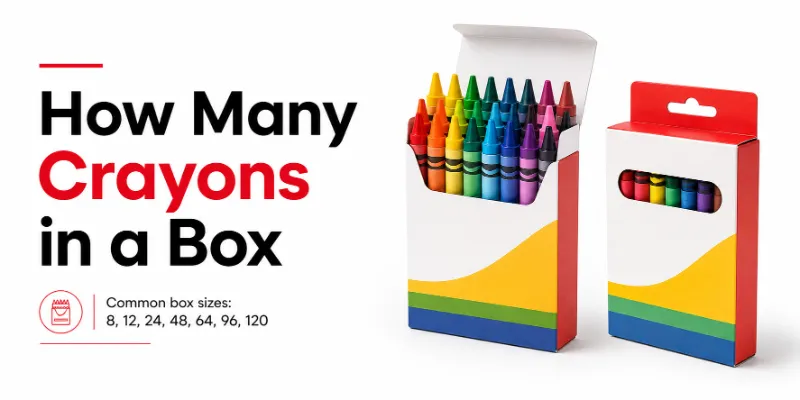
Crayon box count varies by brand, product type, age group, school use, retail format, and packaging purpose. Here is a quick reference for the most common counts:
- 8 crayons — Entry-level packs for toddlers and preschool children
- 12 crayons — Basic school packs covering essential colors
- 16 crayons — Slightly expanded range for early grades
- 24 crayons — The most common standard for school and home use
- 32 crayons — Broader palette for older students
- 48 crayons — Creative packs for art-focused users
- 64 crayons — Large sets popular as gifts and for young artists
- 96 crayons — Premium sets with expanded color ranges
- 120 crayons — Collector and professional-grade sets
- Bulk classroom packs — Large quantities for schools and institutions
The 24-count box is the most widely stocked crayon packaging count in US retail and the most common choice on school supply lists.
Common Crayon Box Quantities Explained
8-Count Crayon Boxes
The classic starter pack. An 8-count box contains the most basic colors red, orange, yellow, green, blue, violet, brown, and black. Designed for toddlers and preschoolers, these packs prioritize simplicity and ease of use. The compact packaging makes them ideal for travel bags, restaurant table activities, party favors, and school welcome kits.
12-Count Crayon Boxes
A 12-count box expands slightly, often adding white, gray, and one or two extra shades. These work well for early elementary school years and are commonly included in school supply kits. The price point is accessible, making them a reliable choice for bulk school purchasing.
16-Count Crayon Boxes
Less common than 12 or 24-count options, the 16-count box bridges the gap for children who have outgrown the basics but do not yet need a full school set. These appear in some retail stationery lines and specialty crayon brands.
24-Count Crayon Boxes
The standard crayon box for school and home use in the United States. A 24-count box provides a solid color range for most coloring projects, worksheets, and classroom artwork without overwhelming young users. This is the count that appears most often on elementary school supply lists and is the dominant format in US retail stores.
32-Count Crayon Boxes
These packs typically add skin tones, additional shades of blue and green, and metallic or glitter options. Less common in mainstream retail, 32-count boxes appear more often in art supply ranges and premium stationery lines.
48-Count Crayon Boxes
The 48-count steps into creative territory. These packs are popular with older children and hobby artists. Packaging for 48-count boxes is usually larger and more structured, often featuring a lid that doubles as a display tray to help users find specific colors quickly.
64-Count Crayon Boxes
Strongly associated with premium crayon brands, the 64-count box is a popular birthday and holiday gift. It typically includes an organizer, a built-in sharpener, or a tray for easy access. A 64-count set offers enough variety to appeal to serious young artists while still being accessible for general home use.
96-Count and 120-Count Crayon Boxes
These sets move into collector and professional art territory. They include vast color ranges with multiple shades of each base color, metallic tones, and specialty hues. Packaging is often rigid, book-style, or layered to organize the full color range effectively. These are common gift choices and popular with art educators.
Bulk Classroom Crayon Packs
Bulk packs are not sold in standard consumer boxes. They typically arrive as large bags, corrugated cartons, or tins containing hundreds of individual crayons or small pre-packed sets. Schools and early childhood programs use these for communal art sessions where cost per crayon matters more than individual presentation.
How Many Colors Come in a Crayon Box?
In most consumer packs, the number of colors matches the number of crayons. A 24-count crayon box includes 24 different colors. A 64-count box includes 64 distinct shades.
In bulk classroom packs, repeated colors are common. High-use colors like red, blue, black, and green are often included in larger quantities because children go through them faster. A bulk pack of 200 crayons might include 20 shades total, with multiple copies of the most popular colors.
Smaller packs focus on primary and secondary colors. Larger packs introduce tertiary shades, metallics, skin tone variations, and specialty colors. A 64-count box, for instance, might include four different shades of blue and a full range of skin tones that smaller sets simply cannot offer.
Standard Crayon Box Size and Packaging Format
There is no single universal standard crayon box size. Physical dimensions depend on crayon count, crayon length and diameter, internal layout, retail display requirements, shipping needs, and brand design decisions.
Common packaging formats include:
- Tuck-end folding cartons — used for small and standard packs (8 to 24 count). Simple, cost-effective, and widely used across US retail.
- Lid and tray boxes — common for medium and large packs (48 to 64 count). The lid lifts off to reveal an organized crayon tray, which also serves as a display.
- Shelf display boxes — used for retail floor units where multiple packs are sold from a shared outer box with individual packs accessible at the front.
- Rigid boxes — used for premium, gift, and collector sets. Heavier and more durable, often finished with quality printing, embossing, or foil accents.
- Bulk corrugated cartons — plain corrugated boxes holding large quantities for schools, institutions, and wholesale distribution.
Crayon Box Count Chart
| Crayon Count | Packaging Format | Best For | Packaging Notes |
|---|---|---|---|
| 8 | Compact tuck-end carton | Toddlers, party favors, travel | Small footprint; basic color range |
| 12 | Small folding carton | Early school, supply kits | Low cost; widely stocked |
| 16 | Mid-size folding carton | Young children, home use | Less common in mainstream retail |
| 24 | Standard tuck-end carton | School, home, general retail | Most common US crayon box count |
| 32 | Mid-size carton or tray | Older children, creative use | Often includes metallics or specialty shades |
| 48 | Lid and tray carton | Art-focused kids, hobby users | Structured interior; larger shelf footprint |
| 64 | Lid and tray or rigid box | Gifts, serious young artists | Often includes sharpener and organizer |
| 96–120 | Rigid or layered collector box | Artists, collectors, premium gifts | Full color range; premium materials |
| Bulk | Corrugated carton or bag | Classrooms, schools, institutions | Colors may repeat; communal-use focus |
Crayon Pack Sizes for Different Users
Toddlers and Young Children
8 or 12-count packs work best. Fewer colors reduce confusion, and smaller boxes are easier to manage. Jumbo crayons designed for small hands typically come in 8-count packs.
School Students
12, 16, or 24-count packs are the standard for elementary school use. Most US school supply lists specify 24 crayons as the default, covering the range needed for classroom art projects.
Teachers and Classrooms
Bulk classroom packs or large corrugated cartons are the practical choice. Buying in bulk lowers cost per crayon and ensures supplies are available through daily losses and breakages.
Artists and Hobby Users
48, 64, 96, or 120-count sets offer the color range, consistency, and quality that creative users look for. An organized tray or layered display helps locate specific shades efficiently.
Retail Stationery Brands
Stocking across 12, 24, 48, and 64-count options covers budget shoppers, school buyers, and gift buyers. A well-planned crayon range serves multiple price points and shopping occasions.
Promotional and Gift Packs
8 or 12-count packs in custom printed boxes work well for brand events, restaurant table activities, school welcome kits, and children’s party favors. These are practical, affordable, and easy to brand.
Why Crayon Box Count Matters
Count affects nearly every aspect of a crayon product’s performance in the market:
- Price point — Higher counts command higher prices, but they also take up more shelf space and add shipping weight. Lower counts are more accessible for families and easier to stock.
- Perceived value — A 64-count box with an organized tray feels like a premium gift. An 8-count tuck-end carton feels like a practical everyday item. Both serve their intended purpose well.
- School supply lists — Most US school supply lists specify 24 crayons. Stocking the 24-count format gives retailers direct alignment with back-to-school demand.
- Retail planning — Different counts require different shelf space allocations. A retail buyer needs to consider how each count performs against competitors and how much space the physical box occupies.
- Shipping and storage — A higher count means more weight per unit, which affects shipping cost. Bulk packs require different storage and handling than individual retail boxes.
Crayon Packaging Count vs Crayon Box Size
These two concepts are related but different.
Crayon packaging count is how many crayons are inside the box. Crayon box size is the physical dimensions of the packaging — length, width, and height.
A 64-count box is physically much larger than an 8-count box. A 48-count box of standard-size crayons is also physically larger than a 48-count box of mini crayons, because box size scales with both count and crayon dimensions.
For retailers and packaging buyers, both numbers matter. Count determines product value and shelf positioning. Physical dimensions determine how many units fit on a shelf, inside a shipping carton, and in a warehouse.
What Makes Good Crayon Packaging?
Strong crayon packaging does more than hold crayons in place. It protects the product during transport, organizes colors for easy access, and communicates value to the buyer at point of sale.
Key features of good crayon packaging include strong paperboard or cardboard material that holds its shape in a school bag, an easy-open design that young children can manage independently, an organized internal layout with inserts or dividers for larger counts, and color visibility through a window panel or open tray. Recyclable packaging options appeal to eco-conscious schools and families. Quality printing reinforces brand identity and supports retail shelf appeal. Durable construction protects against crushing during shipping and storage.
Custom Crayon Boxes for Brands and Retailers
Custom crayon boxes allow stationery brands, toy companies, schools, event planners, restaurants, and retailers to present crayons in packaging that reflects their identity and serves their specific audience.
A private-label crayon line benefits from consistent branding across all count sizes. Custom printed crayon boxes can include logo placement, specific brand colors, window cut-outs for color visibility, structured inserts and dividers, retail-ready layouts, and eco-friendly paperboard options. Promotional crayon packs in custom boxes perform well at corporate events, hospitality settings, and children’s events where branded giveaways make a practical impression.
For bulk buyers and classroom programs, custom packaging can include school logos, district branding, or program names. For retail brands, custom boxes help justify a premium price point and build recognizable shelf identity across the product range.
Final Thoughts on How Many Crayons Are in a Box
Crayon boxes commonly come in 8, 12, 16, 24, 32, 48, 64, 96, and 120-count sizes, while bulk classroom packs can go higher. How many crayons are in a box depends on the brand, user age group, school needs, retail format, and packaging purpose. The 24-count box remains the US standard for school and everyday home use. Larger packs serve creative, gift, and institutional needs. Understanding the different counts helps parents, teachers, retailers, and brands choose packaging that genuinely fits the purpose — and the person using it.
FAQs
1. How many crayons are in a standard box?
A standard crayon box in the United States typically contains 24 crayons. This is the most common count for school and home use. Crayon boxes also come in 8, 12, 16, 32, 48, 64, 96, and 120-count options depending on brand and intended use.
2. What is the most common crayon box count?
The 24-count box is the most common crayon box count in the US. It appears on most elementary school supply lists and is the dominant format in retail stationery sections across the country.
3. Is a 24-count crayon box the most common size?
Yes. The 24-count is the most widely used standard for school and home use. It provides a practical color range at an accessible price, making it the default choice for back-to-school shopping and general retail.
4. How many colors come in a crayon box?
In most consumer packs, the number of colors matches the number of crayons. A 24-count box includes 24 different colors. In bulk classroom packs, high-use colors like red, blue, and black may be repeated.
5. What crayon box size is best for schools?
For individual student use, a 24-count box is the US school standard. For classroom-wide use, bulk packs or large corrugated cartons of individual crayons are more practical and cost-effective.
6. Can crayon boxes be customized for retail brands?
Yes. Custom crayon boxes can be produced in any count configuration with printed branding, logos, window cut-outs, inserts, and eco-friendly materials. Custom boxes are popular for private-label stationery brands, event favors, restaurant packs, and retail product launches.
 Facebook
 Twitter
 LinkedIn
 Pinterest