
 Apparel Boxes
 Soap Boxes
 Candle Boxes
 Bakery Boxes
 Cosmetic Boxes
 Cardboard Boxes
 Vape Boxes
 Pillow Boxes
 CBD Boxes
 Cigarette Boxes
 Hair Extension Boxes
 Retail Boxes
 Hemp Boxes
 Display Boxes
 Jewelry Boxes
 Food Boxes
 Die Cut Boxes
 Toy Boxes
 Window Boxes
 Corrugated Boxes
 Kraft Boxes
 Rigid Boxes
 Mailer Boxes
 Mylar Bags
 Gift Boxes
 Seasonal Boxes
 Custom Labels
 Custom Sticker
 Sport Boxes
 Foldable Boxes
 Gable Boxes
 Insert Boxes
 Sleeve Boxes
 Tuck Boxes
 Tin Packaging
 Tube Packaging
 Small Boxes

If you’ve ever been mid-game and suddenly unsure whether an ace counts as a face card, or found yourself settling a disagreement at the card table, you’re not alone. It’s one of those questions that sounds straightforward but comes with a few layers worth understanding. This guide covers exactly how many face cards are in a standard deck, what qualifies as a face card, how the different suits break down, and a few things that commonly trip people up.
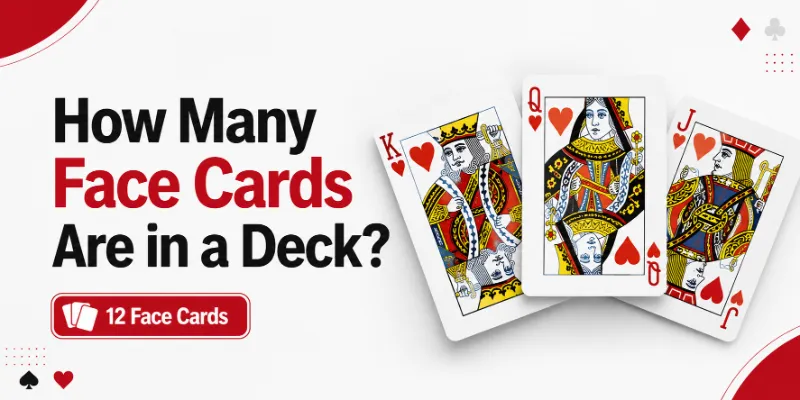
There are 12 face cards in a standard 52-card deck. These are the Jack, Queen, and King across all four suits, including clubs, diamonds, hearts, and spades. Each suit contains three face cards, giving a total of 12. Aces and Jokers are not counted as face cards in standard card game terminology.
A Brief History of Face Cards
Face cards have been part of playing card decks for centuries, and their origins are more layered than most players realise.
Playing cards are believed to have originated in Tang Dynasty China around the 9th century, gradually making their way westward through Persia and into Europe by the late 14th century. Early European decks introduced the concept of court cards, illustrated figures representing royal and noble hierarchy, and it’s from this tradition that the modern Jack, Queen, and King descend.
In early French and English decks, the court cards were often assigned specific historical or mythological identities. The King of Hearts was associated with Charlemagne, the King of Spades with King David, the King of Diamonds with Julius Caesar, and the King of Clubs with Alexander the Great. Similarly, the Queens carried named associations, though these varied between regional traditions.
The Jack was originally called the Knave, a term for a male servant or soldier of lower rank than the Queen. The abbreviation ‘Kn’ was eventually shortened to ‘J’ to avoid confusion with the King’s ‘K’, and the name Jack gradually replaced Knave in common usage across Britain and beyond.
The standardised 52-card deck with four suits and three face cards per suit became the dominant format in Britain by the 18th century and has remained largely unchanged since.
What Is a Face Card?
A face card is any playing card that depicts a human figure rather than a numerical pip count. In a standard Western deck, that means the Jack, Queen, and King, three court cards per suit, each illustrated with a named royal or court figure.
The term “face card” refers to the fact that these cards carry a face and a portrait, rather than a number. They’re sometimes called court cards or picture cards, and all three terms refer to the same group of 12 cards.
Aces, despite often holding high value in games like poker or blackjack, are not face cards. They carry a single pip symbol and no portrait, so they sit outside this category regardless of their gameplay ranking.
How the 12 Face Cards Break Down
A standard deck is divided into four suits: clubs, diamonds, hearts, and spades. Each suit contains 13 cards including Ace through 10, plus Jack, Queen, and King. Of those 13, three are face cards.
Here’s how it breaks down by suit:
- Clubs — Jack of Clubs, Queen of Clubs, King of Clubs
- Diamonds — Jack of Diamonds, Queen of Diamonds, King of Diamonds
- Hearts — Jack of Hearts, Queen of Hearts, King of Hearts
- Spades — Jack of Spades, Queen of Spades, King of Spades
Four suits multiplied by three face cards each equals 12 face cards in total.
Face Cards vs Number Cards: A Quick Comparison
Understanding how face cards differ from number cards helps clarify their role across different games and in the overall structure of the deck.
| Feature | Face Cards | Number Cards |
|---|---|---|
| Visual design | Portrait illustration | Pip symbols |
| Total in deck | 12 | 36 (Ace through 10, excluding face cards) |
| Cards included | Jack, Queen, King | Ace, 2 through 10 |
| Point value in Blackjack | 10 points each | Face value (Ace = 1 or 11) |
| Suits represented | All four | All four |
| Proportion of deck | ~23% | ~77% (including Aces) |
| Common nickname | Court cards, picture cards | Pip cards |
The distinction matters most in points-based games. In blackjack, all 12 face cards carry a value of 10, the same as the pip 10 card, meaning there are 16 cards worth 10 points in total across a 52-card deck. That’s a significant portion, and it’s why drawing a 10-value card is a near-constant strategic consideration at the table.
In games like Rummy or Gin, face cards typically carry a higher points penalty than numbered cards, making them riskier to hold late in a round.
What About Jokers?
Most standard decks include two Joker cards, but Jokers are not part of the 52-card count and are not face cards. They’re supplementary cards used in specific games, such as Canasta or certain Rummy variants, and are typically set aside or removed entirely when playing games that don’t require them.
So whether you’re counting with or without Jokers, the number of face cards remains 12.
Are Aces Face Cards?
No. This is one of the most common points of confusion. Aces are high-value cards in many popular games, which leads people to assume they must be face cards, but they’re not.
An ace carries a single pip and no portrait illustration. In terms of card classification, it sits at the numerical end of the deck, not the court card end. Whether it ranks above or below the King depends entirely on the rules of the game being played, but its classification as a face card doesn’t change; it isn’t one.
Face Cards in Popular Card Games
Understanding which cards are face cards matters in several common games:
- Blackjack — All face cards are worth 10 points. Combined with an ace, they form the strongest possible hand. Knowing there are 12 face cards in a 52-card deck is useful for understanding probability and table strategy.
- Poker — Face cards frequently form strong hands. A hand containing multiple face cards carries significant weight, particularly in games where high card value determines the winner.
- Rummy — Face cards typically carry a higher points penalty if left in hand when another player goes out. Tracking which face cards have been played can inform strategic decisions.
- Snap and Go Fish — Face cards are treated as standard named cards rather than numerical ones, making them collectible sets in their own right.
Common Misconceptions About Face Cards
Misconception 1: There are 16 face cards. This comes from including the Ace in the count alongside the Jack, Queen, and King. Aces are not face cards; they carry no portrait, so the correct total remains 12.
Misconception 2: Jokers are face cards. Jokers do carry illustrated figures, but they are not part of the standard 52-card deck and are not classified as face cards in conventional card game terminology.
Misconception 3: The number varies by deck. In a standard Western playing card deck, the count is always 12. Some novelty or themed decks alter the artwork but retain the same card structure: Jack, Queen, King across four suits.
Misconception 4: All cards with a letter are face cards. Aces are marked with an ‘A’, but they carry no portrait and are not face cards. Only cards depicting a portrait figure, Jack, Queen, King, qualify.
Key Facts Worth Remembering
- A standard deck contains 52 cards across four suits
- Each suit has 13 cards: Ace, 2 through 10, Jack, Queen, King
- Each suit has 3 face cards: Jack, Queen, King
- Total face cards across the full deck: 12
- Face cards as a proportion of the deck: roughly 23%
- Aces: not face cards
- Jokers: not face cards and not part of the 52-card count
Final Thoughts
The answer is straightforward once the terminology is clear: there are 12 face cards in a standard deck, the Jack, Queen, and King across clubs, diamonds, hearts, and spades. Aces aren’t face cards, Jokers don’t count, and the total doesn’t change from deck to deck in standard play.
Whether you’re settling a dispute, brushing up before a game night, or working through card probability, that number,12, is the one to remember.
Looking for Custom Playing Cards or Card Packaging?
If you’re a game brand, event company, promotional business, or retailer looking to produce custom playing cards or bespoke card packaging, presentation matters as much as the product itself. BoxesGen specialises in custom packaging solutions that protect, present, and promote products across retail, gifting, and e-commerce, including tailored packaging for card games, gift sets, and branded merchandise. Get in touch with BoxesGen today for expert packaging guidance and a custom quote built around your product.
FAQs About Face Cards
How many face cards are in a deck of 52 cards?
There are 12 face cards in a standard 52-card deck, three per suit (Jack, Queen, King) across four suits.
Is the Ace a face card?
No. The Ace carries a single pip symbol rather than a portrait, so it is not classified as a face card regardless of its value in any given game.
How many face cards are in each suit?
Each suit contains three face cards: the Jack, Queen, and King.
Are Jokers counted as face cards?
No. Jokers are not part of the standard 52-card deck and are not classified as face cards.
What is another name for a face card?
Face cards are also commonly referred to as court cards or picture cards. All three terms describe the same group: the Jack, Queen, and King.
How many non-face cards are in a deck?
A standard 52-card deck contains 40 non-face cards, the Aces through 10 across all four suits.
What percentage of a deck are face cards?
Face cards make up approximately 23% of a standard 52-card deck (12 out of 52 cards).
 Facebook
 Twitter
 LinkedIn
 Pinterest