
 Apparel Boxes
 Soap Boxes
 Candle Boxes
 Bakery Boxes
 Cosmetic Boxes
 Cardboard Boxes
 Vape Boxes
 Pillow Boxes
 CBD Boxes
 Cigarette Boxes
 Hair Extension Boxes
 Retail Boxes
 Hemp Boxes
 Display Boxes
 Jewelry Boxes
 Food Boxes
 Die Cut Boxes
 Toy Boxes
 Window Boxes
 Corrugated Boxes
 Kraft Boxes
 Rigid Boxes
 Mailer Boxes
 Mylar Bags
 Gift Boxes
 Seasonal Boxes
 Custom Labels
 Custom Sticker
 Sport Boxes
 Foldable Boxes
 Gable Boxes
 Insert Boxes
 Sleeve Boxes
 Tuck Boxes
 Tin Packaging
 Tube Packaging
 Small Boxes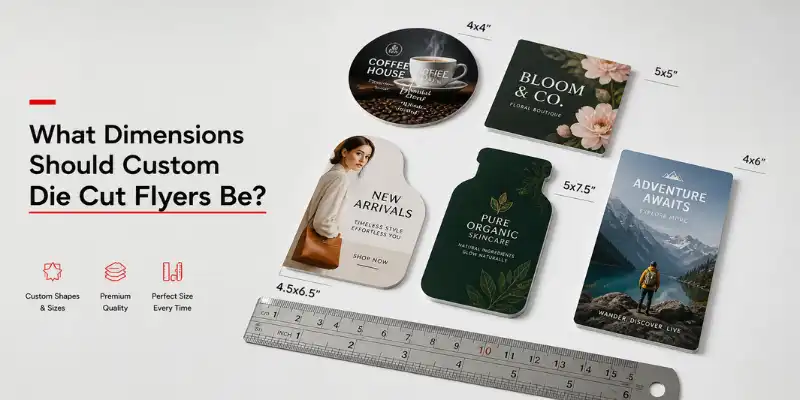
Are you planning to print custom die cut flyers but not sure what size to order? You are not alone. Choosing the wrong dimensions can waste your budget and hurt your marketing results. Getting the right flyer size is one of the most practical decisions you will make for your campaign.
This guide covers everything you need to know about custom die cut flyer dimensions — from standard sizes to printing specs, shapes, and expert tips.
What Are Custom Die Cut Flyers?
Custom die cut flyers are marketing materials cut into unique shapes using a sharp steel die. Unlike standard rectangular flyers, these pieces can be cut into any outline — a logo shape, a product silhouette, or a creative geometric form.
They are popular for product launches, trade shows, retail promotions, and brand campaigns. Their unusual shapes grab attention and stick in memory long after the event.
Why Flyer Dimensions Matter in Marketing
The size of your flyer directly affects readability, portability, and print cost. A flyer that is too small gets ignored. One that is too large becomes difficult to handle and distribute.
Dimensions also determine how much content you can include. They affect how your design breathes on the page. The right size connects your message to your audience efficiently.
From a print perspective, size impacts paper usage, die cost, and finishing options. Getting it right from the start saves both time and money.
Standard Sizes for Custom Die Cut Flyers (U.S. Focus)
Most U.S. print shops work in inches. Here are the most common standard die cut flyer sizes used across the country:
Common Standard Sizes:
- 4 x 6 inches — The most popular size. Works well for events, menus, and promotions.
- 3.5 x 8.5 inches — Also called a “door hanger” format. Great for direct mail and neighborhood campaigns.
- 5.5 x 8.5 inches — Half-letter size. Ideal for product announcements and sales flyers.
- 8.5 x 11 inches — Full letter size. Best for detailed information, catalogs, or showcase pieces.
- 4.25 x 5.5 inches — Quarter-letter. A compact, cost-effective format for coupons and inserts.
These sizes work as starting points. Die cutting allows you to go beyond these rectangles and carve out any shape you want within these base dimensions.
Popular Custom Die Cut Flyer Shapes and Their Dimensions
Die cut technology allows for virtually unlimited shapes. Here are the most commonly ordered shapes and their typical dimensions:
Circle and Oval Flyers
- Standard circle: 4-inch or 5-inch diameter
- Oval: roughly 4 x 6 inches
These work well for food brands, wellness companies, and event promotions.
Rounded Corner Flyers
Most popular size: 4 x 6 inches with 0.25-inch corner radius
These feel premium and modern without adding much to the cost.
Custom Shape Flyers (Logo or Product Outline)
These are cut to your exact shape specifications.
Minimum recommended size: 3 x 3 inches for legibility.
Anything smaller risks losing design detail after cutting.
Half-Circle and Arch Shapes
Typically 4 x 4 inches or 5 x 5 inches
Used heavily in real estate, beauty, and luxury branding.
Leaf, Star, or Irregular Shapes
Usually fit within a 4 x 4 inch or 5 x 7 inch bounding box.
More complex cuts may increase the die cost slightly.
How to Choose the Right Size for Your Business
The right flyer size depends on three things: your message, your distribution method, and your audience.
Ask yourself these questions before ordering:
- Will this flyer be handed out, mailed, or displayed in a stand?
- How much text and imagery do you need to include?
- Will people carry this in a pocket or bag?
For events and trade shows, a 4 x 6 inch or 5 x 7 inch flyer works best. It is easy to hand out and large enough to display your brand clearly.
For direct mail campaigns, go with a 4.25 x 5.5 inch or 6 x 9 inch format. These fit standard envelopes and comply with USPS size guidelines.
For retail inserts or product packaging, a 3 x 5 inch or 4 x 6 inch die cut card works perfectly.
Printing Considerations: Bleed, Trim, and Safe Area
This is where many first-time buyers make costly mistakes. Understanding print specs keeps your flyer looking professional.
Bleed
Add a 0.125-inch (1/8 inch) bleed on all sides. This extra area ensures colors and images print to the very edge without white borders after trimming.
Trim Line
The trim line is your actual finished flyer size. For a 4 x 6 inch flyer, your document should be set up at 4.25 x 6.25 inches to account for bleed.
Safe Area
Keep all critical content — text, logos, and important graphics — at least 0.125 inches inside the trim line. This is the “safe zone.” Anything outside it risks being cut off.
Resolution
Always design at 300 DPI for print. Screen resolution (72 DPI) will look blurry in print. This is non-negotiable for professional results.
Materials and Finishes That Impact Size Choice
The material and finish you choose can affect how your flyer is handled and perceived. Some finishes also influence which sizes work best.
Paper Stock Options:
- 100 lb. gloss cover — Crisp, vibrant, and affordable. Works for all sizes.
- 16 pt. card stock — Thicker and more durable. Ideal for sizes 4 x 6 inches and larger.
- Kraft paper — Natural, eco-friendly look. Popular for food, wellness, and artisan brands.
Finish Options:
- Gloss coating — Enhances color richness. Best for bold, image-heavy designs.
- Matte coating — Gives a soft, upscale feel. Works well with minimalist designs.
- Spot UV — Adds a raised shiny area over select parts. Often used on 5 x 7 inch or larger flyers for maximum impact.
Thicker stock on very small shapes can make the flyer feel stiff and difficult to distribute. For intricate die cut shapes under 3 x 3 inches, stick to lighter stock.
Common Mistakes to Avoid When Choosing Flyer Dimensions
Even experienced marketers make these errors. Avoid them and you will save time and reprint costs.
- Ignoring bleed settings. Forgetting to add bleed is the number one cause of reprints. Always set up your file with proper bleed from the start.
- Choosing a shape that is too intricate. Highly detailed die cuts can tear or lose definition on lightweight paper. Keep sharp points to a minimum unless using thick stock.
- Going too small for the message. A 2 x 2 inch flyer might look trendy but rarely has room for legible contact info. If you need to communicate details, go with at least a 4 x 6 inch format.
- Not checking USPS regulations for mailers. If you are mailing flyers directly, irregular shapes must meet postal size and weight requirements. Always verify before printing.
- Using low-resolution artwork. Supplying 72 DPI files for a large-format flyer will always result in blurry output. Use vector files or high-resolution raster art.
The 3Ps Approach: Presentation, Preservation, Protection
Whether you are using flyers alone or as part of a branded package, the 3Ps framework helps you think through your print strategy.
Presentation — Your flyer dimensions and shape should reflect your brand identity. A luxury brand should choose refined shapes and premium finishes. A bold, playful brand can go with bright colors and unexpected cuts.
Preservation — If flyers will be stored, shipped, or displayed over time, choose a heavier stock with a protective coating. Uncoated flyers scuff easily in transit.
Protection — For flyers bundled inside product packaging or mailers, size them to fit the enclosure without folding. A folded die cut flyer can ruin the die cut edge and damage the design.
Applying the 3Ps helps you make decisions that go beyond just dimensions. It aligns your flyer with the full customer experience.
Conclusion: Get the Right Size and Stand Out
Choosing the right dimensions for your custom die cut flyers is not a guessing game. It is a strategic decision that affects your design, budget, and marketing results.
Start with a proven standard size like 4 x 6 or 5 x 7 inches. Then work with an experienced printer to explore shapes and finishes that align with your brand.
At BoxesGen, we help businesses across the U.S. create high-quality custom die cut flyers in any size or shape. Whether you need a simple rounded card or a fully custom silhouette, our team handles the details so your brand gets noticed.
Ready to order your custom die cut flyers? Get a free quote from BoxesGen today and bring your marketing materials to life.
Frequently Asked Questions (FAQ)
What is the standard size for die cut flyers?
The most common standard size for die cut flyers in the U.S. is 4 x 6 inches. Other popular options include 5 x 7 inches, 5.5 x 8.5 inches, and 4.25 x 5.5 inches. The best size depends on your content, distribution method, and budget.
Can custom die cut flyers be any shape?
Yes. Die cutting allows flyers to be cut into virtually any shape — circles, ovals, stars, product outlines, logos, or completely custom silhouettes. The main constraint is that very intricate shapes may require thicker paper stock to hold their form after cutting.
What is the best size for promotional flyers?
For most promotions, a 4 x 6 inch flyer is the best balance of visibility, cost, and portability. If you need more room for content, a 5.5 x 8.5 inch or 8.5 x 11 inch size works well for detailed campaigns.
What bleed size should I use for die cut flyers?
Always set up your file with a 0.125-inch (1/8 inch) bleed on all sides. This prevents unwanted white edges after the die cuts through. Keep all text and important graphics at least 0.125 inches inside the finished trim line.
Are die cut flyers more expensive than regular flyers?
Yes, die cut flyers typically cost more than standard rectangular flyers. The added cost comes from creating or using a custom die tool and the additional production step. However, the cost difference is often small, especially for standard shapes. The marketing impact usually justifies the investment.
What resolution should my die cut flyer artwork be?
Your artwork should be at least 300 DPI (dots per inch) at the final print size. Low-resolution files produce blurry or pixelated print output. For the sharpest results, use vector files (AI, EPS, or PDF) whenever possible.
What paper stock works best for die cut flyers?
For most die cut flyers, 100 lb. gloss cover or 16 pt. card stock are the most popular choices in the U.S. Heavier stock works better for intricate shapes and adds a premium feel. Lighter paper stocks work fine for simpler shapes and high-volume print runs.