
 Apparel Boxes
 Soap Boxes
 Candle Boxes
 Bakery Boxes
 Cosmetic Boxes
 Cardboard Boxes
 Vape Boxes
 Pillow Boxes
 CBD Boxes
 Cigarette Boxes
 Hair Extension Boxes
 Retail Boxes
 Hemp Boxes
 Display Boxes
 Jewelry Boxes
 Food Boxes
 Die Cut Boxes
 Toy Boxes
 Window Boxes
 Corrugated Boxes
 Kraft Boxes
 Rigid Boxes
 Mailer Boxes
 Mylar Bags
 Gift Boxes
 Seasonal Boxes
 Custom Labels
 Custom Sticker
 Sport Boxes
 Foldable Boxes
 Gable Boxes
 Insert Boxes
 Sleeve Boxes
 Tuck Boxes
 Tin Packaging
 Tube Packaging
 Small Boxes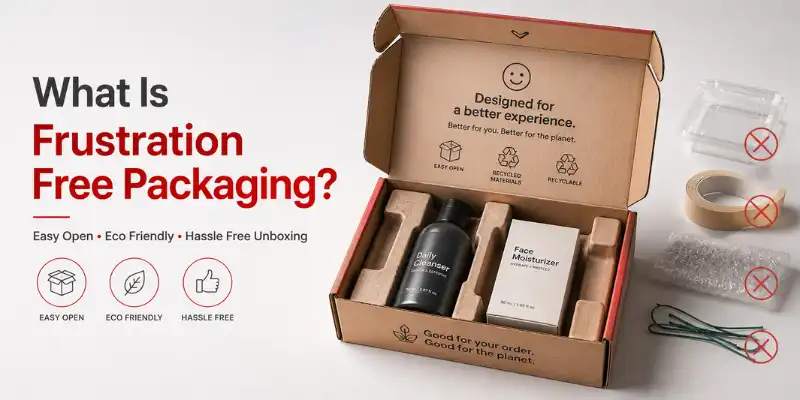
AI Overview
Frustration free packaging is a packaging design approach that makes products easy to open without tools, uses minimal materials, and prioritizes recyclable or eco-friendly components. Introduced by Amazon in 2008, it reduces plastic waste, lowers carbon emissions, and improves the customer experience. Americans love it for its convenience, safety, and environmental benefits making it a leading trend in sustainable e-commerce packaging.
You just ordered something online. It finally arrives. You’re excited. Then… the battle begins.
You’re tugging at impossible plastic clamshells. You’re hunting for scissors. You’re fighting zip ties, wire twists, and layers of foam that seem engineered by someone who genuinely dislikes you.
Sound familiar? You’re not alone.
Millions of Americans deal with this exact frustration every single day. In fact, there’s even a term for it — wrap rage. It’s that very real anger you feel when packaging defeats you before you even get to enjoy what’s inside.
That’s exactly why frustration free packaging became one of the most welcomed changes in modern retail. It didn’t just solve a minor inconvenience — it transformed the entire customer experience. And Americans? They absolutely love it.
Let’s break down what it is, where it came from, and why it’s changing how products are shipped and sold across the country.
What Is Frustration Free Packaging?
Frustration free packaging (FFP) is a design philosophy focused on making product packaging simple, easy to open, and environmentally responsible.
Instead of layers of hard plastic, excessive foam, twist ties, and oversized boxes, frustration free packaging uses:
- Minimal materials — only what’s needed to protect the product
- Recyclable cardboard or paper-based materials
- No wire ties or plastic clamshells
- Easy-open designs that require no tools
The goal is simple: the customer should be able to open their product in seconds — without scissors, without frustration, and without a trip to the recycling bin holding a garbage bag full of plastic.
It’s also closely tied to sustainable packaging and eco-friendly packaging trends, since using less material means less waste and a smaller environmental footprint.
The History of Frustration Free Packaging
Amazon Started It All
The term “frustration free packaging” was officially introduced by Amazon in 2008. The company launched its Frustration-Free Packaging program after recognizing that customers were genuinely unhappy with the packaging experience — especially for holiday gifts.
Amazon partnered with brands like Fisher-Price, Mattel, and Lexar to redesign their packaging to be:
- Easier to open
- Safer (no sharp edges or cut hazards)
- Fully recyclable
- Right-sized for shipping — meaning no giant boxes for tiny products
The program was a massive hit. Customers responded with better reviews, fewer returns, and stronger brand loyalty.
Since then, Amazon has expanded the program significantly. Thousands of products now carry the FFP badge, and sellers are often incentivized — or even required — to meet Amazon’s packaging standards.
A Growing National Trend
Amazon didn’t just create a program — it sparked a national conversation about packaging waste in America. As sustainability became a bigger priority for consumers, brands across every industry started rethinking how they packaged their products.
Today, eco-conscious packaging is no longer a nice-to-have. For many American consumers, it’s a dealbreaker.
Why Americans Love Frustration Free Packaging
Americans have embraced this shift for some very clear, very personal reasons.
1. Pure Convenience
Nobody wants to spend 10 minutes opening a $15 item. Frustration free packaging respects your time. You open the box, pull out the product, and you’re done. It’s that simple.
2. Eco-Friendliness and Reduced Waste
Americans are increasingly eco-conscious. Studies show that over 70% of U.S. consumers consider sustainability when making purchasing decisions. Frustration free packaging directly supports this by using less plastic and more recyclable materials.
Less packaging = less guilt at the trash can.
3. Safer for Kids and Seniors
Traditional clamshell packaging sends thousands of people to the emergency room each year due to cuts from sharp plastic edges. For children and elderly consumers, this is a genuine safety concern.
Frustration free packaging eliminates that risk entirely. No sharp edges. No struggle. Just easy access.
4. Better Unboxing Experience
In the age of social media and unboxing videos, the experience of opening a product matters more than ever. Clean, minimal packaging feels premium. It signals that a brand cares about the details — and customers notice.
5. Easier Recycling
Most traditional packaging mixes materials — cardboard, plastic, foam — making recycling complicated. Frustration free packaging typically uses single-stream recyclable materials, making disposal simple and responsible.
Key Features: Frustration Free vs. Traditional Packaging
Environmental Benefits That Make a Real Difference
This is where frustration free packaging goes beyond convenience — it’s genuinely good for the planet.
Reduced Carbon Footprint
Lighter, smaller packages mean fewer trucks needed to ship the same number of products. That translates directly to lower fuel consumption and fewer carbon emissions across the supply chain.
Less Cardboard and Plastic Waste
Amazon reported that its FFP program has eliminated millions of pounds of packaging waste since its launch. That’s a staggering amount of cardboard and plastic that never ends up in a landfill.
Better Recycling Efficiency
When packaging is made from a single recyclable material — like corrugated cardboard — recycling facilities can process it far more efficiently. Mixed materials often get rejected at recycling centers, so simplifying packaging actually improves real-world recycling rates.
Aligns with Sustainability Goals
Major corporations are under growing pressure to hit sustainability targets. Adopting eco-friendly packaging and sustainable shipping practices helps brands meet those goals while also appealing to environmentally aware consumers.
Industries Leading the Frustration Free Packaging Movement
Almost every consumer product category has something to gain from this shift. The companies that move early are building loyalty now.
Pros and Cons of Frustration Free Packaging
Overall, the pros heavily outweigh the cons — especially as materials and design processes continue to improve.
Frustration Free Packaging vs. Traditional Packaging: A Deeper Look
The math is becoming increasingly clear for brands. The short-term savings on traditional packaging are often wiped out by higher return rates, damaged goods, and negative reviews.
How Brands Benefit from Making the Switch
Brands that adopt frustration free and sustainable packaging aren’t just doing the right thing — they’re making a smart business decision.
- Higher customer satisfaction scores — Opening ease directly impacts product reviews
- Fewer returns and damage claims — Right-sized packaging protects products better
- Stronger brand trust — Consumers respect brands that take sustainability seriously
- Better positioning for Amazon’s algorithm — FFP-certified products often rank higher
- Word-of-mouth and social sharing — A clean unboxing experience gets shared online
Patagonia, Apple, and Seventh Generation are just a few brands that have built strong reputations partly through their commitment to responsible, minimal packaging. Consumers remember — and they reward brands that get it right.
The Future of Frustration Free Packaging in America
The momentum isn’t slowing down. If anything, it’s accelerating.
Sustainability Regulations Are Coming
Several U.S. states are already introducing extended producer responsibility (EPR) laws that hold brands accountable for their packaging waste. As federal regulations catch up, frustration free and sustainable packaging will become less of a choice and more of a requirement.
Smart Packaging Is on the Rise
The next frontier includes smart packaging — QR codes, NFC chips, and digital inserts replacing physical instruction booklets. This further reduces material use while enhancing the customer experience.
Eco-Conscious Consumers Are the New Majority
Gen Z and Millennials now make up the largest segment of American consumers — and both groups rank sustainability as a top purchasing priority. Brands that don’t adapt risk being left behind entirely.
Biodegradable and Compostable Materials
Beyond recyclable, the next step is biodegradable packaging made from mushroom mycelium, seaweed, or cornstarch-based materials. Several startups are already scaling these solutions for mainstream use.
The future of packaging in America is clear: less is more, and simple is better.
Frequently Asked Questions (FAQs)
Q1: What does frustration free packaging mean?
Frustration free packaging refers to packaging that is easy to open without tools, uses minimal materials, and is made from recyclable or eco-friendly components. It was popularized by Amazon’s FFP program launched in 2008.
Q2: Is frustration free packaging the same as eco-friendly packaging?
They overlap significantly. FFP is typically eco-friendly by design — it uses less plastic and more recyclable materials. However, not all eco-friendly packaging qualifies as frustration free, and vice versa.
Q3: How do I know if a product has frustration free packaging?
On Amazon, look for the “Frustration-Free Packaging” badge on the product listing. It indicates the product meets Amazon’s certified packaging standards.
Q4: Does frustration free packaging cost more?
There can be upfront design and transition costs for brands. However, studies and brand case studies show that savings from reduced returns, lower shipping costs, and less material usage often offset those initial costs over time.
Q5: Is frustration free packaging better for the environment?
Yes. FFP significantly reduces plastic use, lowers carbon emissions through lighter shipments, and uses recyclable materials that are easier to process at recycling facilities.
Q6: Which brands use frustration free packaging?
Many major brands participate in Amazon’s FFP program, including Fisher-Price, Mattel, Philips, Logitech, and hundreds of others. Many brands have also adopted similar principles independently.
Q7: Can frustration free packaging protect products as well as traditional packaging?
Absolutely. FFP is designed to protect the product using right-sized, structurally sound packaging — without the excess. Damage rates with properly designed FFP are comparable to or lower than traditional packaging.
Q8: Is frustration free packaging available for all products?
Not yet for every category, but it’s expanding rapidly. Products that are fragile, liquid, or irregularly shaped may require additional packaging considerations, but solutions are continuously improving.
Conclusion: A Simpler, Smarter Way to Shop
Here’s the bottom line: Americans are done fighting their packages.
The days of needing scissors, a utility knife, and 10 minutes of your life just to open a pair of headphones are numbered. Frustration free packaging is not a trend — it’s a permanent shift in how Americans expect products to arrive at their door.
It’s better for consumers. It’s better for the planet. And increasingly, it’s better for business too.
Whether you’re a shopper who just wants to enjoy your purchase without the drama, or a brand looking to build real loyalty in a competitive market — frustration free packaging delivers on every level.