
 Apparel Boxes
 Soap Boxes
 Candle Boxes
 Bakery Boxes
 Cosmetic Boxes
 Cardboard Boxes
 Vape Boxes
 Pillow Boxes
 CBD Boxes
 Cigarette Boxes
 Hair Extension Boxes
 Retail Boxes
 Hemp Boxes
 Display Boxes
 Jewelry Boxes
 Food Boxes
 Die Cut Boxes
 Toy Boxes
 Window Boxes
 Corrugated Boxes
 Kraft Boxes
 Rigid Boxes
 Mailer Boxes
 Mylar Bags
 Gift Boxes
 Seasonal Boxes
 Custom Labels
 Custom Sticker
 Sport Boxes
 Foldable Boxes
 Gable Boxes
 Insert Boxes
 Sleeve Boxes
 Tuck Boxes
 Tin Packaging
 Tube Packaging
 Small Boxes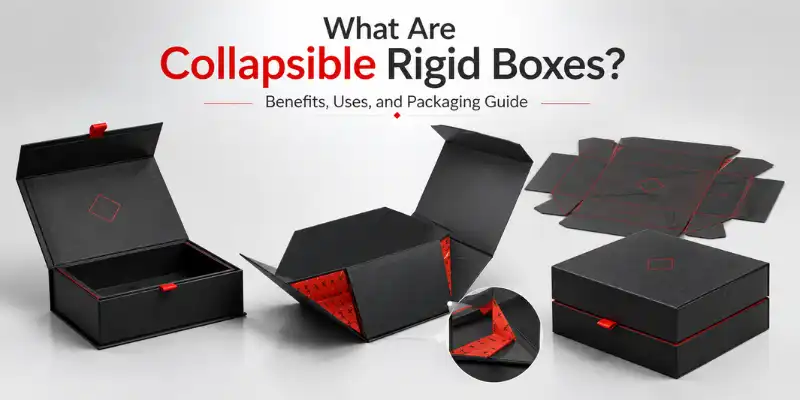
Collapsible rigid boxes are premium, high-density paperboard packaging boxes that fold flat for efficient storage and shipping, then assemble into sturdy luxury boxes using magnetic closures, adhesive corners, or folding panels. They offer the same premium appearance and structural strength as traditional rigid boxes while reducing warehousing and transportation space by up to 75%. These boxes are also known as foldable rigid boxes, collapsible magnetic boxes, and collapsible luxury packaging.
When it comes to premium packaging, few options deliver the impact of collapsible rigid boxes. These sophisticated packaging solutions combine the structural integrity and luxury feel of rigid boxes with the practical advantages of foldable design. Whether you’re shipping high-end cosmetics, jewelry, electronics, or gift items, collapsible rigid boxes offer brands a distinctive way to elevate their unboxing experience while maintaining operational efficiency.
In this comprehensive guide, we’ll explore what makes collapsible rigid boxes a preferred choice for luxury packaging, their construction, applications, and why leading brands are increasingly turning to this innovative packaging format.
What Are Collapsible Rigid Boxes?
Collapsible rigid boxes are premium packaging containers engineered to fold flat for storage and shipping, then form a rigid structure when assembled. Unlike traditional rigid boxes that ship pre-assembled and take up significant warehouse space, collapsible designs fold down to minimal dimensions, reducing storage costs and environmental impact.
The term “rigid” refers to the board material itself—typically a dense, high-quality paperboard ranging from 1.5mm to 3mm in thickness. This provides the substantial, premium feel that luxury brands demand. The “collapsible” aspect comes from the structural design, where the box features folding mechanisms that allow it to compress into a flat state without losing its ability to form a sturdy, protective container.
These boxes maintain the aesthetic and protective qualities of rigid boxes while offering the space-saving benefits of foldable packaging. This hybrid approach has become essential for ecommerce businesses managing inventory and shipping costs without sacrificing brand presentation.
How Foldable Rigid Boxes Work
The engineering behind foldable rigid boxes involves strategic score lines and fold patterns that allow the structure to collapse and expand. Here’s how they function:
Fold-Flat Design
Foldable rigid boxes utilize precision-cut score lines that guide the material to fold in specific directions. The scoring is calculated to exact specifications so the box collapses smoothly without cracking or weakening the board. When flat, the box resembles a flat-pack structure similar to furniture assembly, though the process is significantly simpler.
Assembly Process
Assembly requires minimal effort from the user. Most collapsible rigid boxes feature an intuitive design where side flaps fold up, bottom panels snap or tuck into place, and the lid closes securely. No tape, glue, or complex steps are necessary. High-end versions include magnetic closures that click into place, creating a satisfying, premium feel that enhances the unboxing experience.
Structural Integrity
The rigidity comes from the dense paperboard core and the way the box is engineered to distribute weight evenly once assembled. The fold lines don’t compromise structural strength because they’re incorporated into the design architecture rather than being afterthoughts. This allows collapsible rigid boxes to protect delicate items just as effectively as traditional rigid boxes.
Benefits of Collapsible Rigid Packaging
Cost Efficiency in Storage and Shipping
The most immediate advantage is the dramatic reduction in shipping volume. A collapsible rigid box that measures 8″ x 6″ x 4″ when assembled might compress to roughly 1/4 of that volume when flat. For businesses managing thousands of orders monthly, this translates to significant savings in warehouse space, pallet allocation, and freight costs.
Shipping costs directly correlate to dimensional weight. Flat boxes reduce dimensional weight charges, making collapsible rigid boxes particularly valuable for premium brands managing tight margins on luxury items.
Environmental Impact
Flat-pack design inherently reduces the carbon footprint associated with shipping. Fewer trucks are needed to transport the same quantity of packaging, resulting in lower fuel consumption and emissions. Many brands are responding to consumer demand for sustainable practices by switching to collapsible options, even when they cost slightly more than traditional rigid boxes.
Additionally, because customers can repurpose or recycle these boxes more easily, they align with broader sustainability initiatives that resonate with environmentally conscious consumers.
Superior Brand Experience
Collapsible rigid boxes deliver a premium unboxing experience that’s difficult to achieve with corrugated or standard folding cartons. The weight and structural feel communicate quality immediately. When combined with luxury finishing options like soft-touch lamination, foil stamping, or embossing, these boxes create memorable brand moments that customers photograph and share on social media.
The assembly process itself can be part of the experience. Some brands intentionally highlight the ease of assembly as part of their sustainability narrative or convenience story.
Luxury Branding Advantages
For premium brands, collapsible rigid boxes function as a tangible brand asset. The unboxing moment has become crucial to customer perception, particularly in luxury markets.
Rigid construction provides a canvas for sophisticated printing and finishing techniques. Brands can incorporate embossed logos, metallic foil accents, custom color printing via Pantone matching, and matte or gloss lamination finishes that simply don’t work on flimsy packaging. The structural quality supports these premium finishes without any compromise.
Magnetic closure systems add another layer of luxury. The soft click of a quality magnetic closure signals craftsmanship and attention to detail. These systems are particularly popular in cosmetics, skincare, jewelry, and premium gift packaging where the tactile experience matters as much as visual design.
Storage and Shipping Benefits
Beyond cost savings, collapsible rigid boxes offer practical operational advantages that simplify supply chain management.
Warehouse Efficiency
Flat boxes stack efficiently on standard warehouse shelving. A single pallet can hold significantly more units compared to pre-assembled rigid boxes. This frees up valuable warehouse space for inventory growth or reduces the overall facility footprint needed to support operations.
Shipping Flexibility
Because boxes arrive flat, businesses can order in bulk without the pressure of immediate space availability. Flat-pack design also makes it easier to store different box styles and sizes without excessive space requirements. This flexibility encourages brands to experiment with custom sizing or seasonal packaging variations.
Inventory Management
Digital tracking and inventory management become simpler when boxes are stored flat. Rotation follows a standard first-in-first-out pattern, and stock checks are straightforward since flat boxes are easier to count and organize than assembled structures.
Common Materials Used in Collapsible Rigid Boxes
Primary Board Materials
Rigid Paperboard is the foundation of these boxes. Premium versions use virgin fiber paperboard or a combination of virgin and recycled fibers. Common thicknesses range from 1.5mm (two-piece board) to 3mm (three-piece board construction).
Two-Piece Board consists of a dense paper core sandwiched between thin outer layers. This construction provides rigidity while keeping weight manageable.
Three-Piece Board features a thicker central core for maximum rigidity. This is preferred for heavy items or luxury applications where absolute structural integrity is paramount.
Specialty Liners
Interior linings often include kraft paper, colored paper, or specialty finishes. Molded pulp inserts can be added to protect items during transit. Some premium applications include velvet, satin, or custom-printed paper liners that enhance the interior experience.
Sustainability Considerations
Increasingly, manufacturers offer collapsible rigid boxes made from 100% recycled paperboard or from responsibly sourced virgin fibers. FSC (Forest Stewardship Council) certification is available for brands prioritizing environmental credentials.
Printing and Finishing Options
Collapsible rigid boxes support virtually every printing and finishing technique used in luxury packaging:
Print Quality
CMYK Printing delivers full-color, photographic-quality images. Digital and offset printing methods are both viable, depending on order volume and budget.
Pantone Color Matching allows brands to match exact brand colors, ensuring consistency across all packaging touchpoints.
Premium Finishes
Soft-Touch Lamination applies a velvety matte finish that feels luxurious and reduces fingerprints. This finish has become standard in cosmetics, beauty, and premium electronics packaging.
Matte and Gloss Lamination provides protection while controlling the surface appearance. Matte suggests sophistication and sustainability; gloss adds visual pop and can highlight product photography.
Foil Stamping applies metallic or specialty metallic finishes to logos, text, or design elements. Gold, silver, rose gold, and holographic foils are popular choices that instantly elevate brand perception.
Embossing and Debossing creates tactile dimensional effects. Raised logos or surface patterns add texture and premium feel without additional color application.
Spot UV applies a glossy protective coating to specific design areas, creating contrast and drawing attention to key brand elements. The difference between matte lamination and spot UV-treated areas creates visual interest.
Closure Systems
Magnetic Closures are integrated into the top and bottom of the box using small neodymium magnets. They provide a satisfying click and keep lids securely closed. This system is available in hidden configurations that don’t disrupt the visual design.
Fold-Over Closures feature a lid that folds and tucks into place. This system is cost-effective and works well for light to medium-weight items.
Ribbon Closures add luxury while providing functional closure. The ribbon threads through slots or wraps around the box, combining aesthetics with utility.
Magnetic Collapsible Rigid Boxes
Magnetic closure systems represent the premium tier of collapsible rigid box options. These boxes integrate small but powerful neodymium magnets into the structural design, allowing the lid to snap shut with precision and remain securely closed without additional fasteners.
Why Magnetic Systems Matter
The tactile feedback of a strong magnetic closure reinforces brand quality. Luxury brands—particularly in cosmetics, skincare, jewelry, and premium electronics—find that magnetic systems justify their higher cost through enhanced perceived value.
Magnets are embedded during the manufacturing process, either at the box walls or in integrated components. The strength and positioning are precisely calculated so the closure is effortless yet secure.
Applications
Magnetic systems work exceptionally well for:
- Cosmetics and skincare packaging
- Luxury jewelry boxes
- Premium tech accessories
- High-end subscription boxes
- Designer apparel boxes
- Gift packaging for corporate clients
Eco-Friendly Collapsible Rigid Boxes
Sustainability in packaging has moved from niche marketing to competitive necessity. Collapsible rigid boxes align naturally with eco-conscious brand values.
Material Advantages
Flat-pack design reduces dimensional weight and shipping volume, lowering carbon emissions per unit shipped. This is a concrete, measurable environmental benefit—not just marketing language.
Recyclable and Compostable
Most collapsible rigid boxes made from paperboard are 100% recyclable and compostable. Unlike plastic-heavy packaging, they break down cleanly in recycling streams and don’t introduce microplastics into the environment.
FSC-Certified Options
Sourcing from FSC-certified suppliers ensures responsible forest management. Many premium brands now require this certification as part of their sustainability commitments.
Design Considerations
Minimizing inks, eliminating plastic liners, using water-based coatings, and choosing recyclable closures all contribute to a genuinely sustainable packaging solution. Brands can highlight these choices in marketing without greenwashing concerns.
Best Industries Using Collapsible Gift Boxes
Collapsible rigid boxes have become the default choice across numerous industries:
Beauty and Cosmetics rely heavily on these boxes for foundation, blush, perfume, and skincare lines. The luxury presentation directly impacts purchase decisions and social media marketing.
Jewelry and Luxury Goods use collapsible boxes to convey exclusivity and craftsmanship. The premium materials and finishes align perfectly with the product category.
Electronics and Accessories benefit from the protective rigidity combined with flat-pack efficiency. Tech brands appreciate the sustainability angle while maintaining brand prestige.
Apparel and Fashion use these boxes for premium collections, limited editions, and gift sets. The unboxing experience directly influences customer perception and brand loyalty.
Subscription Boxes leverage collapsible designs for monthly or quarterly shipments. The flat-pack economics work at volume scales while the luxury feel justifies premium subscription pricing.
Premium Gifts and Corporate Packages rely on collapsible boxes to impress recipients. Custom printing and finishes allow companies to create branded gift presentations.
Health and Wellness Products use these boxes for supplement sets, skincare collections, and wellness kits where premium positioning is essential.
Difference Between Traditional Rigid Boxes and Foldable Rigid Boxes
Understanding the distinctions helps brands make informed packaging decisions:
| Characteristic | Traditional Rigid Boxes | Foldable Rigid Boxes |
|---|---|---|
| Shipping Volume | Pre-assembled; takes significant space | Flat-pack; 75% reduction in volume |
| Assembly | Ships ready to use; no setup required | Quick fold-and-assemble; typically under 30 seconds |
| Storage Efficiency | Requires extensive warehouse space | Palletizes efficiently in minimal footprint |
| Shipping Costs | Higher dimensional weight charges | Reduced shipping costs due to flat profile |
| Customization Speed | Longer lead times due to assembly | Can be quicker for certain configurations |
| Premium Feel | Excellent; substantial and protective | Excellent; maintained through rigid materials |
| Sustainability | Standard recycling credentials | Lower carbon footprint per shipment |
| Unit Cost | Generally lower for large volumes | Slightly higher but offset by shipping savings |
| Ideal for | Very high volume, standard sizes | Custom requirements, multiple SKUs, sustainability focus |
The choice depends on order volume, target market, budget considerations, and logistical infrastructure. Many large brands use both formats strategically based on product category and market positioning.
How to Choose the Right Size and Style
Selecting appropriate dimensions and structural configurations requires considering multiple factors:
Product Protection
The box must accommodate your product with appropriate protective padding. Oversized boxes waste material and create shifting during transit. Undersized boxes compromise protection and can damage products or appear cheap.
Standard recommendations suggest 1-2 inches of padding on all sides for fragile items like cosmetics or jewelry. Electronics may require additional padding based on the item’s fragility.
Brand Positioning
Budget boxes typically start at 2″ x 2″ x 2″ and scale up. Premium gift boxes often range from 4″ x 4″ x 4″ to 8″ x 8″ x 8″ depending on contents. The size communicates value—too small appears cheap; too large suggests wasteful packaging.
Shipping Economics
Calculate dimensional weight charges based on actual dimensions. A 6″ x 6″ x 6″ box might be the same shipping weight as an 8″ x 4″ x 4″ box. Testing different dimensions with your shipping carrier can reveal optimal configurations that save money without compromising quality.
Target Market
Luxury markets expect substantial, well-proportioned packaging. Mass-market segments may accept smaller boxes. Consider customer expectations in your industry when finalizing dimensions.
Closure Preference
Fold-over closures work for lighter items and create a sleeker appearance. Magnetic closures add cost but deliver premium feel. Ribbon closures combine function with luxury aesthetics.
Trends in Premium Collapsible Packaging Boxes
The packaging industry continues to evolve, and several trends are shaping the future of collapsible rigid boxes:
Minimalist Design Philosophy
Brands increasingly favor clean, uncluttered designs that prioritize typography and white space. This approach reduces printing complexity while creating sophisticated, memorable designs. Paired with premium finishes like soft-touch matte or embossing, minimalist designs communicate confidence and luxury.
Sustainability as Competitive Advantage
Eco-friendly collapsible boxes have moved from premium option to standard expectation. Brands are competing on transparency about material sourcing, recycling credentials, and carbon footprint. FSC certification and 100% recyclable materials are becoming baseline requirements.
Personalization and Limited Editions
Digital printing and modular designs allow brands to create personalized or limited-edition packaging without traditional volume requirements. This enables direct-to-consumer brands to offer customized unboxing experiences at scale.
Integrated Inserts and Accessories
Custom molded pulp inserts, satin liners, tissue wrapping, and branded stickers are increasingly integrated into collapsible box designs. These elements create complete brand experiences rather than basic protective packaging.
Multifunctional Design
Boxes designed for dual purposes—containing product initially, then functioning as storage, display, or decorative items—appeal to consumers seeking value beyond the initial purchase. This encourages customers to keep and repurpose packaging, extending brand visibility.
Tech Integration
NFC tags, QR codes, and augmented reality elements are being incorporated into packaging designs. These interactive elements create engagement opportunities that extend the unboxing experience into the digital realm.
Dimensions Chart: Common Collapsible Rigid Box Sizes
| Industry | Common Dimensions | Product Type | Recommended Box Style |
|---|---|---|---|
| Cosmetics | 4″ x 4″ x 2.5″ | Foundation, powder, blush | Hinged or magnetic lid |
| Cosmetics | 3.5″ x 3.5″ x 3.5″ | Luxury skincare | Magnetic closure |
| Jewelry | 5″ x 5″ x 2″ | Rings, earrings | Magnetic or ribbon closure |
| Jewelry | 6″ x 6″ x 3″ | Necklaces, bracelets | Magnetic with interior padding |
| Apparel | 8″ x 6″ x 4″ | Scarves, accessories | Fold-over or magnetic |
| Electronics | 7″ x 5″ x 3″ | Phone cases, chargers | Magnetic with insert |
| Electronics | 9″ x 7″ x 4″ | Tech accessories, cables | Magnetic closure |
| Gift Packaging | 6″ x 6″ x 4″ | Multi-item sets | Ribbon or magnetic |
| Subscription Boxes | 10″ x 8″ x 4″ | Monthly product boxes | Magnetic or fold-over |
| Luxury Goods | 8″ x 8″ x 3″ | Premium branded items | Magnetic with custom insert |
Printing and Finishing Best Practices
Pre-Production Considerations
Work with your packaging manufacturer to supply print files in the correct format (typically PDF or high-resolution digital files). Provide structural mockups to ensure designs align with fold lines and assembly points.
Discuss color standards—whether Pantone matching, CMYK, or custom spot colors—to achieve consistent results across production runs.
Finish Application
Soft-touch matte lamination should be applied after printing to protect graphics and enhance the tactile feel. This finish reduces gloss and fingerprints, ideal for premium positioning.
Foil stamping is typically applied after lamination. Ensure sufficient pressure and temperature to create clean, consistent metallic effects without damaging the box structure.
Embossing and debossing create permanent tactile elements. These are especially effective on monochromatic designs where texture becomes the primary visual interest.
Spot UV should be applied to highlight specific design elements—logos, text, or design details—to create visual contrast without coating the entire surface.
Quality Control
Request preproduction samples showing all finish combinations. Color consistency, finish quality, and structural integrity should be verified before full production runs.
FAQ: Collapsible Rigid Boxes Explained
Are collapsible rigid boxes durable?
Yes, absolutely. Collapsible rigid boxes manufactured from dense paperboard (typically 1.5mm to 3mm thickness) provide excellent durability and product protection. The structural integrity is maintained through the manufacturing process—fold lines are engineered to distribute stress without compromising strength. Properly designed collapsible boxes protect products as effectively as traditional rigid boxes while offering the space-saving advantages of flat-pack design.
What materials are used in foldable rigid boxes?
Foldable rigid boxes primarily use high-quality rigidpaperboard, typically virgin fiber or recycled fiber blends. Two-piece board construction (paper core with outer layers) is common for standard applications, while three-piece board provides maximum rigidity for heavier items. Interior linings may include kraft paper, colored paper, or specialty finishes. FSC-certified and 100% recyclable options are available for brands prioritizing sustainability.
Are magnetic collapsible rigid boxes reusable?
Yes, magnetic closures are designed for repeated use. Many customers keep these boxes after purchase for storage, gifting, or decoration. The magnetic closure mechanism doesn’t degrade with normal handling, and the rigid construction withstands repeated opening and closing. This durability supports the sustainability narrative and extends brand visibility as customers repurpose packaging.
Are collapsible rigid boxes eco-friendly?
Collapsible rigid boxes offer significant environmental advantages compared to traditional rigid boxes. The flat-pack design reduces shipping volume and carbon emissions. Most are made from recyclable paperboard that breaks down cleanly in standard recycling streams. FSC-certified options ensure responsible forest management. Water-based inks and coatings further reduce environmental impact. However, eco-friendliness depends on material sourcing and finish selections—discuss specific environmental credentials with your manufacturer.
What industries use collapsible gift boxes?
Collapsible rigid boxes are used across luxury and premium sectors: beauty and cosmetics, jewelry, electronics, high-end apparel, subscription services, pharmaceutical and wellness products, corporate gifts, and specialty retail. Any industry where unboxing experience and brand positioning matter benefits from collapsible rigid box solutions. E-commerce brands particularly favor these boxes for their cost efficiency and sustainability positioning.
Can collapsible rigid boxes be custom printed?
Completely. Collapsible rigid boxes support every printing and finishing technique used in premium packaging. Full-color CMYK printing, Pantone color matching, foil stamping, embossing, debossing, soft-touch lamination, matte and gloss finishes, and spot UV are all available. Custom printing allows brands to incorporate logos, patterns, photography, and messaging that align with brand identity. Lead times and minimum quantities vary by printing method and complexity.
Conclusion
Collapsible rigid boxes represent the intelligent evolution of luxury packaging. They deliver the premium feel and substantial quality that sophisticated brands demand while solving real operational challenges around storage, shipping, and sustainability.
The engineering is elegant—precision-folded structures that collapse to minimal volume yet maintain the rigidity and protective qualities of traditional rigid boxes. The finishing options are extensive, supporting embossed logos, foil accents, soft-touch lamination, and magnetic closures that create memorable unboxing experiences.
For brands managing cost pressures without compromising quality perception, collapsible rigid boxes offer the best of both worlds. They’re particularly valuable in competitive markets where the unboxing moment influences purchase decisions and social media marketing.
Whether you’re shipping cosmetics, jewelry, electronics, or premium gifts, collapsible rigid boxes provide a sophisticated, economical, and environmentally responsible packaging solution that resonates with today’s consumers while supporting your bottom line.
Ready to explore custom collapsible rigid boxes for your brand? Work with an experienced packaging partner like BoxesGen who understands structural engineering, printing capabilities, and material sourcing. The right box design becomes an asset that protects products, elevates brand perception, and supports your growth strategy in premium markets.