
 Apparel Boxes
 Soap Boxes
 Candle Boxes
 Bakery Boxes
 Cosmetic Boxes
 Cardboard Boxes
 Vape Boxes
 Pillow Boxes
 CBD Boxes
 Cigarette Boxes
 Hair Extension Boxes
 Retail Boxes
 Hemp Boxes
 Display Boxes
 Jewelry Boxes
 Food Boxes
 Die Cut Boxes
 Toy Boxes
 Window Boxes
 Corrugated Boxes
 Kraft Boxes
 Rigid Boxes
 Mailer Boxes
 Mylar Bags
 Gift Boxes
 Seasonal Boxes
 Custom Labels
 Custom Sticker
 Sport Boxes
 Foldable Boxes
 Gable Boxes
 Insert Boxes
 Sleeve Boxes
 Tuck Boxes
 Tin Packaging
 Tube Packaging
 Small Boxes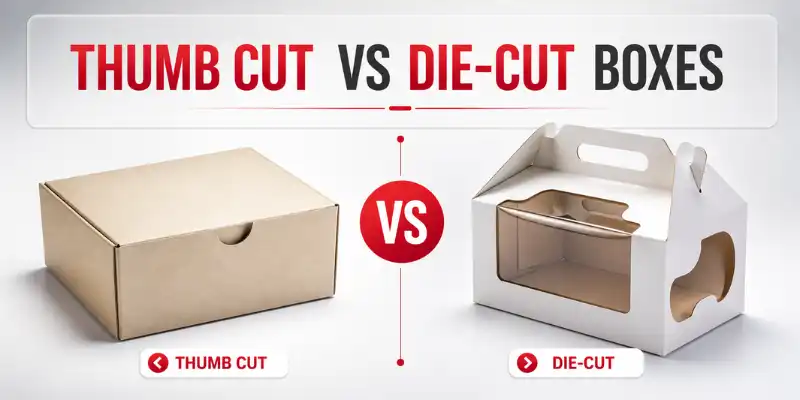
When it comes to choosing the right custom packaging, even the smallest structural detail can make or break your product’s performance on the shelf. Two of the most frequently asked-about box styles in the commercial packaging world are thumb cut boxes and die-cut boxes. On the surface, both sound like simple design choices, but in practice, they serve very different functional and branding purposes.
With over a decade of experience in custom box manufacturing and commercial print packaging, one thing is absolutely clear brands that align their packaging structure with their product needs and consumer expectations consistently outperform those that treat packaging as an afterthought. So if you are someone trying to figure out whether to go for thumb cut or die-cut boxes for your retail packaging, this in-depth guide is exactly what you need. Let’s break it all down so you can walk away with a confident decision.
What Are Thumb Cut Boxes?
A thumb cut box is a style of packaging that features a small, semi-circular notch cut into the lid, edge, or front panel of the box. This notch is specifically designed to allow easy access — the user simply places their thumb into the cut-out and lifts the lid or slides out the inner tray without any struggle. Simple? Yes. Effective? Absolutely.
In the commercial packaging industry, thumb cut boxes are most commonly manufactured from cardboard, kraft paper, or corrugated board. The structural integrity of these boxes remains fully intact; the thumb notch is a precision cut that adds functionality without compromising the strength or the presentation of the box.
Common Use Cases for Thumb Cut Boxes
- Matchboxes, drawer-style packaging, and sliding tray boxes
- Cosmetic and skincare product inserts
- Retail shelf-ready packaging for small electronics or accessories
- Gift boxes and premium personal care kits
- Subscription box inserts requiring repeated open-and-close use
Key Benefits of Thumb Cut Packaging
- Improved user convenience — especially critical for elderly consumers or premium unboxing experiences
- No extra hardware like magnets or ribbon pulls needed
- Cost-effective structural addition with a high perceived value
- Works seamlessly with auto-lock base styles and sleeve packaging
- Clean, minimal aesthetic that appeals across most product categories
If your product demands ease of access above everything else and your packaging budget needs to stay lean, thumb cut boxes are a reliable and smart solution.
What Are Die-Cut Boxes?
Die-cut boxes are an entirely different category. The term ‘die-cutting’ refers to a manufacturing process where a custom steel rule die — essentially a sharp, shaped blade — is pressed into a flat sheet of cardboard, kraft, or corrugated material to cut it into a specific shape or pattern. This process allows for virtually unlimited customization in terms of shape, structure, and design.
Unlike standard box styles that follow fixed dimensions and folds, die-cut packaging can be engineered into almost any form. Window cutouts, interlocking flaps, custom inserts, unique geometric shapes, hanging tabs for retail pegboards — all of these are made possible through the die-cutting process. It is, without a doubt, one of the most versatile and widely used techniques in custom packaging solutions.
Common Use Cases for Die-Cut Boxes
- Retail display packaging with window cutouts for product visibility
- Food packaging for bakery items, chocolates, and confectionery
- Electronics packaging requiring custom foam or cardboard inserts
- Cosmetics and luxury goods packaging with intricate structural designs
- E-commerce shipping boxes with self-locking structures
- Corrugated packaging for fragile or high-value items
Key Benefits of Die-Cut Packaging
- Complete design freedom — any shape, any cutout, any structure
- Supports high-impact printing techniques including CMYK, spot UV, and embossing
- Strengthens retail shelf presence with unique structural forms
- Reduces the need for additional packaging materials through smart engineering
- Scales efficiently for high-volume bulk orders once the die is ready
If your packaging needs to stand out on a crowded retail shelf, deliver a premium unboxing experience, or hold a product with specific structural requirements, die-cut boxes give you that competitive edge.
Key Differences Between Thumb Cut and Die-Cut Boxes
To make the comparison easier, here is a side-by-side breakdown of how these two packaging styles differ across the most important performance and cost factors.
| Feature | Thumb Cut Boxes | Die-Cut Boxes |
|---|---|---|
| Design Flexibility | Limited – semi-circular notch only | Unlimited – any shape or cut |
| Primary Function | Easy product access via thumb grip | Structural design + display appeal |
| Cost | Lower – simpler tooling | Moderate to higher – custom die |
| Best For | Retail shelf products, quick access | Premium, display-heavy, and custom packaging |
| Material Compatibility | Cardboard, kraft, corrugated | Cardboard, kraft, corrugated, rigid board |
| Production Speed | Faster – less complex tooling | Slightly longer due to custom die setup |
| Consumer Experience | Convenience-focused | Aesthetics + convenience combined |
| Customization Level | Moderate | High – virtually limitless |
Pros and Cons of Each Packaging Style
Thumb Cut Boxes — Pros
- Simple, clean design that does not overcomplicate the packaging
- Lower tooling and production cost compared to custom die setups
- Faster turnaround times, ideal for brands with tighter lead times
- Great user experience for drawer-style and sliding tray box formats
- Works well with both kraft and standard cardboard packaging
Thumb Cut Boxes — Cons
- Limited to notch-based design — no structural variation beyond that
- Not ideal for products that require complex inserts or display windows
- Less visually distinctive on a retail shelf compared to custom die-cut forms
Die-Cut Boxes — Pros
- Offers maximum design flexibility for shape, structure, and visual cutouts
- Supports a wide range of printing and finishing techniques for premium appeal
- Stronger shelf presence and better product storytelling through structure
- Ideal for brands aiming for a high-end, luxury, or highly customized look
- Corrugated die-cut options provide excellent protection for fragile goods
Die-Cut Boxes — Cons
- Initial die setup cost is higher — not always ideal for very small production runs
- Slightly longer lead time due to die fabrication for first-time orders
- Requires more technical planning at the design and pre-press stage
Which One Should You Choose?
The honest answer is it depends on what your product actually needs and what your brand wants to communicate. Here is a practical guide to help you make this decision without overthinking it.
Go for Thumb Cut Boxes if:
- Your product uses a drawer-style or sliding tray box format
- You want a user-friendly access feature without inflating your packaging budget
- Your packaging design is already finalized and you just need a clean functional addition
- You are targeting a minimalist or utilitarian consumer audience
Go for Die-Cut Boxes if:
- Your product needs to stand out visually on a retail shelf or in an e-commerce unboxing
- Your packaging requires window cutouts, hanging tabs, or complex structural forms
- You are launching a premium product line where packaging is part of the brand experience
- Your production volume is high enough to absorb the one-time die setup cost efficiently
- You are working with corrugated packaging for fragile or specialty goods
In many cases, die-cut boxes also incorporate thumb cut notches as a feature — so it is not always an either-or decision. At BoxesGen, we regularly engineer hybrid solutions that combine structural die-cutting with thumb cut access points, giving brands the best of both worlds.
Industries That Use These Packaging Styles
Both thumb cut and die-cut boxes have wide applications across industries. Understanding which sectors rely on which style can also help you validate your packaging choice.
Thumb Cut Box Applications by Industry
- Cosmetics and personal care: sliding drawer packaging for lipsticks, serums, and kits
- Consumer electronics: accessory trays and small gadget packaging
- Retail gifting: premium gift boxes with inner sliding compartments
- Stationery and office: matchbox-style packaging for specialty items
Die-Cut Box Applications by Industry
- Food and beverage: window boxes for bakery, chocolates, and premium confectionery
- Cosmetics and beauty: custom structural boxes with cutout windows and inserts
- Electronics and tech: rigid die-cut boxes for headphones, watches, and devices
- Pharmaceutical: tamper-evident, custom-fit product packaging
- E-commerce and DTC brands: self-locking, shipping-optimized corrugated packaging
Customization Options for Both Packaging Styles
Whether you go with thumb cut or die-cut packaging, the level of customization available through professional box manufacturers like BoxesGen is extensive. Here is what you can typically work with.
Materials
- Kraft paper: eco-friendly, natural look, great for artisan and organic brands
- Standard cardboard: cost-effective, smooth surface ideal for full-color printing
- Corrugated board: single, double, or triple wall for heavy-duty protective packaging
- Rigid chipboard: premium feel for luxury product packaging
Printing Techniques
- CMYK offset and digital printing for vibrant, full-color designs
- Pantone spot color matching for brand-consistent packaging
- Spot UV coating for selective gloss effects on matte backgrounds
- Soft-touch lamination for a premium tactile finish
- Foil stamping in gold, silver, or custom colors for luxury appeal
- Embossing and debossing for dimensional logo and design effects
Finishing Options
- Gloss or matte lamination on inner and outer surfaces
- Aqueous or varnish coating for added durability
- Perforation lines for easy opening and tear-away sections
- Custom inserts made from foam, cardboard, or molded pulp
Why Choose BoxesGen for Your Custom Packaging Needs?
At BoxesGen, we have spent years working directly with brands across retail, e-commerce, cosmetics, food, and electronics — and what sets us apart is not just our manufacturing capability, it is our understanding of what packaging actually needs to do in the real world.
From your first consultation to final production, here is what you can expect when working with us:
- Free packaging consultancy — our expert team helps you identify the right structure, material, and finish before you spend a single dollar on tooling
- Custom thumb cut and die-cut boxes engineered to your exact product dimensions
- Bulk order capabilities with competitive pricing that does not compromise quality
- Food-safe, BPA-free, and certified materials available across all box styles
- Full printing and finishing services in-house, ensuring consistent quality control
- Fast turnaround times with support for both short-run and large-scale production
Whether you are a startup launching your first product line or an established brand revamping your retail packaging, BoxesGen brings the expertise, materials, and manufacturing precision needed to get your packaging right the first time.
Final Thoughts
Choosing between thumb cut and die-cut boxes ultimately comes down to understanding your product, your audience, and your brand positioning. Thumb cut boxes offer practical, clean, and cost-effective access features best suited for drawer-style or tray-based packaging. Die-cut boxes open the door to unlimited structural creativity, making them the preferred choice for brands that want their packaging to do more — protect better, display smarter, and communicate louder.
The key is to not guess. Analyze your product needs, review your budget, evaluate your target market, and make a decision rooted in function first and aesthetics second. If you need expert guidance to make the right call, our team at BoxesGen is always ready to walk you through it — at no cost. Reach out today and let’s build packaging that actually works for your product.
Frequently Asked Questions (FAQs)
1. Can a box have both a thumb cut and a die-cut design?
Yes, absolutely. Many custom packaging solutions combine both features. For example, a die-cut rigid box can also include a thumb cut notch on the inner tray for easier product access. This hybrid approach is quite common in premium cosmetics and electronics packaging.
2. Are thumb cut boxes more affordable than die-cut boxes?
Generally, yes. Thumb cut packaging involves a simpler tooling setup and a less complex production process, which typically results in lower per-unit and setup costs. Die-cut boxes require a custom steel rule die, which has a one-time fabrication cost that gets more economical at higher order quantities.
3. What materials work best for die-cut packaging?
Die-cutting works effectively across most packaging materials including cardboard, kraft paper, corrugated board, and rigid chipboard. The choice of material depends on your product weight, desired finish, and whether the packaging needs to meet food-grade or safety certifications.
4. How do I know which box style is right for my product?
Start by evaluating your product’s physical characteristics — its weight, fragility, shelf life, and how consumers are expected to interact with it. If easy access is the priority, a thumb cut is a strong option. If structural uniqueness, display functionality, or complex inserts are required, die-cut packaging is the better route. When in doubt, connect with the BoxesGen team for a free consultation.
5. Does BoxesGen offer low minimum order quantities for custom die-cut boxes?
Yes. BoxesGen works with brands at different scales, from startups placing smaller runs to large enterprises requiring bulk production. Our team evaluates your requirements and provides a packaging solution that balances quality, customization, and cost-effectiveness regardless of order size.