 Apparel Boxes
 Soap Boxes
 Candle Boxes
 Bakery Boxes
 Cosmetic Boxes
 Cardboard Boxes
 Vape Boxes
 Pillow Boxes
 CBD Boxes
 Cigarette Boxes
 Hair Extension Boxes
 Retail Boxes
 Hemp Boxes
 Display Boxes
 Jewelry Boxes
 Food Boxes
 Die Cut Boxes
 Toy Boxes
 Window Boxes
 Corrugated Boxes
 Kraft Boxes
 Rigid Boxes
 Mailer Boxes
 Mylar Bags
 Gift Boxes
 Seasonal Boxes
 Custom Labels
 Custom Sticker
 Sport Boxes
 Foldable Boxes
 Gable Boxes
 Insert Boxes
 Sleeve Boxes
 Tuck Boxes
 Tin Packaging
 Tube Packaging
 Small Boxes

AI Overview
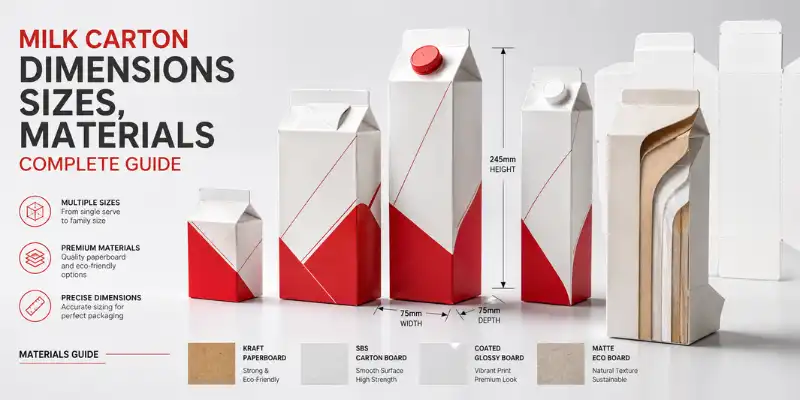
Milk carton dimensions vary by size and market. In the US, common sizes include a half-pint (3.75″ × 1.875″ × 1.875″), quart (7″ × 3.5″ × 3.5″), and half-gallon (9.5″ × 3.875″ × 3.875″), with standard packaging ranging from 8 oz to 1 gallon. Cartons are typically made from polyethylene-coated paperboard, HDPE plastic, or multi-layer Tetra Pak materials. Sizes and materials differ across US, UK, and EU markets, which impacts shelf efficiency, transportation, and environmental sustainability.
Why Does a Milk Carton’s Size Actually Matter?
Pick up any milk carton. It feels familiar, right? You probably don’t give it a second thought — you just grab it, pour, and move on.
But behind that simple cardboard box is a world of precise engineering, carefully calculated dimensions, and material science that affects everything from shelf life to shipping costs to environmental impact.
For packaging buyers, dairy brands, retailers, and even curious consumers — understanding milk carton dimensions matters more than you’d think.
Get the size wrong and you’re wasting materials, losing shelf space, and frustrating customers. Get it right and you’re optimizing costs, extending freshness, and building brand trust.
This guide covers everything — standard milk carton sizes in both inches and centimeters, materials, regional differences, environmental comparisons, and expert tips that most packaging guides completely miss.
A Brief History of the Milk Carton
Before we get into dimensions, a little context helps.
Milk wasn’t always sold in cartons. For most of the 19th century, milk was delivered in glass bottles — heavy, breakable, and expensive to transport.
In 1915, John Van Wormer patented the first paper milk carton design. He called it the “Pure-Pak.” It was a paperboard container with a gable top — the same triangular folded top you still see today on many milk cartons.
By the 1950s, paper milk cartons had largely replaced glass bottles in the United States. They were lighter, cheaper to produce, and far easier to ship and stack.
Then came Tetra Pak in 1952, developed by Swedish engineer Ruben Rausing. His aseptic carton design — which sealed milk in a sterile environment — changed global dairy packaging forever. It allowed milk to be stored without refrigeration for months, which was revolutionary.
Today, milk cartons are a $12+ billion global industry, and the design principles from those early innovations still drive modern packaging standards.
Types of Milk Carton Materials
Not all milk cartons are created equal. The material used directly affects freshness, cost, recyclability, and consumer experience.
1. Paperboard (Gable Top Cartons)
This is the classic milk carton most Americans grew up with. It’s made from multi-layer paperboard — typically a combination of paper, polyethylene (PE), and sometimes aluminum foil.
Best for: Fresh milk requiring refrigeration Shelf life: 2–3 weeks refrigerated
2. Tetra Pak (Aseptic Cartons)
Tetra Pak cartons use a 6-layer structure: paperboard, PE, and aluminum foil combined in a highly specific sequence. This keeps oxygen and light out completely.
Best for: UHT (ultra-high temperature) milk, shelf-stable products Shelf life: 6–12 months without refrigeration
3. HDPE Plastic Jugs
Common for half-gallon and gallon sizes in the US. High-density polyethylene is durable, leak-proof, and inexpensive.
Best for: Large volume retail Shelf life: 2–3 weeks refrigerated
4. Glass (Niche/Specialty Market)
Making a comeback in premium and organic markets. Heavy and expensive but loved for taste purity and recyclability.
Best for: Local dairy, premium brands Shelf life: 2–3 weeks refrigerated
Internal Lining Materials — What’s Really Inside Your Carton
This section is almost always skipped by competitor blogs. It shouldn’t be — it’s critically important.
Polyethylene (PE) Lining
Most standard gable-top milk cartons are coated on the inside with a thin layer of low-density polyethylene (LDPE). This creates a moisture barrier, prevents leakage, and keeps the paperboard from absorbing the milk.
The downside? That PE lining is exactly why milk cartons are tricky to recycle. The paper and plastic need to be separated — something most standard recycling facilities can’t do easily.
Aluminum Foil Layer
Tetra Pak and other aseptic cartons include a thin aluminum foil layer between the paperboard and PE. This layer is the key to long shelf life — it acts as a complete barrier against oxygen, light, and microorganisms.
Without it, even ultra-pasteurized milk would spoil within days.
Bio-Based PE (Emerging Standard)
Some forward-thinking brands — including several in the EU — are now switching to plant-based polyethylene made from sugarcane. It performs identically to fossil-fuel PE but has a significantly lower carbon footprint.
Standard Milk Carton Dimensions — Complete Size Guide
Here’s what most people actually come to find. Let’s go beyond what competitors provide — including volume in ounces and liters, weight capacity, and both inch and centimeter measurements.
Half Pint Milk Carton (School Size)
This is the carton you remember from school lunch lines. Small, single-serve, and iconic.
Volume: 8 fl oz / 0.24 liters Weight when full: Approx. 0.52 lbs / 236g Primary use: Schools, airlines, single-serve hospitality
Pint Milk Carton
Less common in retail but widely used in food service environments.
Volume: 16 fl oz / 0.47 liters Weight when full: Approx. 1.08 lbs / 490g Primary use: Cafeterias, food service, specialty retail
Quart Milk Carton
The quart is the everyday mid-size option — popular with smaller households and specialty milks.
Volume: 32 fl oz / 0.95 liters Weight when full: Approx. 2.15 lbs / 975g Primary use: Households, specialty/organic milk, coffee shops
Half Gallon Milk Carton
The most popular size for American families. Fits most refrigerator door shelves perfectly.
Volume: 64 fl oz / 1.89 liters Weight when full: Approx. 4.4 lbs / 1.99 kg Primary use: Household retail — most purchased milk size in the US
Gallon Milk Carton (HDPE Jug)
The gallon is typically sold in HDPE plastic jugs rather than paperboard in the US, though paperboard gallons do exist.
Volume: 128 fl oz / 3.78 liters Weight when full: Approx. 8.6 lbs / 3.9 kg Primary use: Families, bulk buyers, food service
Regional Differences: US vs UK vs EU Packaging Sizes
This is a major gap in almost every competitor article. Packaging is not the same worldwide — and if you’re sourcing or selling internationally, this matters enormously
Key insight: The EU strongly favors Tetra Pak aseptic cartons for UHT milk, while the US and UK lean heavily on HDPE plastic. This reflects not just consumer preference but also infrastructure — Europe’s grocery stores often have less refrigeration space, making shelf-stable aseptic packaging more practical.
Environmental Impact Comparison: Which Packaging Actually Wins?
Consumers are asking this more than ever. Here’s an honest, research-backed breakdown.
The often-overlooked factor: When evaluating environmental impact, food waste must be included. Tetra Pak’s long shelf life means far less milk gets thrown away — which, when calculated across millions of units, can actually make it more environmentally responsible than “greener-sounding” short-shelf-life packaging.
How Packaging Design Affects Shelf Life
This is another gap in most guides. The physical design of a milk carton directly influences how long the milk stays fresh.
- Gable top openings expose more surface area when opened — increasing oxidation and shortening freshness after opening
- Screw cap additions on modern gable tops have extended post-opening freshness by 2–3 days
- Opaque materials (paperboard, HDPE) protect milk from light degradation — a major cause of off-flavors
- Aseptic sealing (Tetra Pak) creates a near-zero oxygen environment pre-opening, extending shelf life dramatically
- Carton geometry affects stacking efficiency in transport — poor stacking leads to pressure damage and early spoilage
Cost Impact of Different Carton Sizes
Understanding the economics helps packaging buyers make smarter decisions.
Common Manufacturing Mistakes in Milk Carton Sizing
Packaging businesses lose significant money — and customer trust — from these avoidable errors.
- Undersizing the base: A base that’s even slightly too narrow causes cartons to tip during transport and on retail shelves
- Ignoring headspace: Not accounting for 5–8% expansion space can cause leakage when milk is shaken or warmed during transit
- Inconsistent gable fold depth: Variations as small as 1–2mm in the gable top fold affect seal integrity and leak resistance
- Wrong PE coating thickness: Too thin = moisture penetration; too thick = recycling difficulty and unnecessary cost
- Miscalculating stacking weight: Standard retail shelf stacking puts 3–4 carton heights of weight on bottom cartons — undersized bases crack under this pressure
- Ignoring regional size standards: Designing for US dimensions then selling in EU markets without adjusting is a costly mistake many small brands make
Expert Tips for Packaging Businesses
These insights come from real-world packaging operations — things you won’t find in a basic spec sheet.
- Always prototype before full production. Even a 2mm dimension error multiplied across 100,000 units is an expensive problem.
- Specify your fill weight, not just volume. Milk density varies slightly by fat content — whole milk is heavier than skim. Design for your heaviest product variant.
- Consider refrigerator shelf dimensions. Standard US refrigerator door shelves are 10–12 inches tall. A half-gallon carton at 9.5 inches fits; a gallon at 10.5 inches often doesn’t without door modification.
- Test seal integrity at temperature extremes. Cartons travel through loading docks, trucks, and warehouses before reaching refrigeration. Seals must hold at 40°F and 95°F.
- Request FSC-certified paperboard. Forest Stewardship Council certification is increasingly required by major retailers and is a strong sustainability selling point.
- Think about the pour spout early. Consumers rate pour experience as one of the top packaging frustration points — design it in from the start, not as an afterthought.
How to Choose the Right Milk Carton Size for Your Brand
Picking the wrong size doesn’t just affect convenience — it impacts cost, waste, and brand perception. Here’s a simple decision framework:
- Choose Half Pint if: You’re supplying schools, airlines, hotels, or single-serve foodservice operations.
- Choose Pint if: You’re targeting specialty markets, coffee shops, or premium products where smaller portions justify higher per-unit pricing.
- Choose Quart if: You’re launching an organic, specialty, or plant-based milk where consumers want freshness in a manageable size.
- Choose Half Gallon if: You’re competing in mainstream retail — this is the sweet spot for American families and the highest-volume segment.
- Choose Gallon if: You’re targeting large families, wholesale clubs, or food service. Be prepared for HDPE plastic as the dominant format at this size.
Frequently Asked Questions
What are the standard dimensions of a half-gallon milk carton?
A standard half-gallon milk carton measures approximately 9.5 inches tall by 3.875 inches wide by 3.875 inches deep (24.13 cm × 9.84 cm × 9.84 cm). It holds 64 fluid ounces or 1.89 liters.
What are milk cartons made of?
Most milk cartons are made from multi-layer paperboard coated with polyethylene (PE) on the inside. Aseptic cartons (like Tetra Pak) also include an aluminum foil layer for extended shelf life without refrigeration.
What size is a school milk carton?
School milk cartons are the half-pint size — 8 fluid ounces (0.24 liters). They typically measure 3.75 inches tall by 1.875 inches wide and deep.
Are milk cartons recyclable?
It depends on your local facility. Gable-top paperboard cartons have a PE lining that complicates recycling. Many municipalities now accept them in curbside recycling, but some require drop-off at specialized facilities. Tetra Pak cartons need specific processing equipment.
How do milk carton sizes differ between the US and Europe?
The US commonly sells milk in half-gallon (1.89L) and gallon (3.78L) sizes. Europe typically uses 1-liter Tetra Pak cartons for shelf-stable UHT milk. The UK favors HDPE plastic bottles measured in pints (2-pint and 4-pint are most common).
What is the difference between Tetra Pak and regular milk cartons?
Regular gable-top cartons are designed for refrigerated fresh milk with a 2–3 week shelf life. Tetra Pak aseptic cartons use a 6-layer construction including aluminum foil to block oxygen and light, allowing milk to be stored unrefrigerated for 6–12 months.
How much does a full gallon milk carton weigh?
A full gallon of milk weighs approximately 8.6 pounds (3.9 kg). The carton or jug itself adds roughly 0.1–0.2 lbs depending on material.
What is the best milk carton size for a small dairy brand launching in retail?
For most new retail dairy brands, the quart (32 oz) and half-gallon (64 oz) sizes offer the best balance of consumer appeal, margin, and shelf presence. Start with the half-gallon for mainstream positioning or the quart for premium/specialty positioning.
People Also Ask
How tall is a gallon milk jug?
A standard gallon milk jug (HDPE) is approximately 10.5 inches (26.67 cm) tall.
What are the dimensions of a Tetra Pak milk carton?
A standard 1-liter Tetra Pak carton is approximately 6.3 inches (16 cm) tall with a base of roughly 2.5 × 2.5 inches (6.35 × 6.35 cm), though dimensions vary by specific Tetra Pak format.
Why are milk cartons that shape?
The rectangular gable-top design maximizes stacking efficiency, minimizes shelf space per unit volume, and allows efficient filling on automated production lines — all while being structurally sound enough to hold liquid safely.
Final Word: Packaging Dimensions Are a Business Decision
Milk carton dimensions aren’t just numbers on a spec sheet. They determine your shipping costs, shelf placement, consumer experience, environmental footprint, and ultimately — your brand’s success in a competitive dairy market.
Whether you’re a packaging buyer sourcing cartons for a new dairy line, a retailer evaluating shelf space efficiency, or a brand manager comparing sustainable options — the details in this guide give you the foundation to make smarter decisions.
Ready to source the right milk carton for your brand? Work with a certified packaging manufacturer who can provide custom dimension quotes, material samples, and FSC-certified options. The right partner will help you balance cost, sustainability, and consumer experience — without compromise.
BoxesGen is a trusted custom packaging solution provider that helps dairy brands, food businesses, and retailers get the exact packaging they need — built to precise dimensions, made from high-quality sustainable materials, and delivered at competitive prices.
Whether you need:
- Custom-sized milk cartons — half pint to gallon and everything in between
- Eco-friendly paperboard packaging with FSC-certified materials
- Custom printed cartons that make your brand stand out on retail shelves
- Bulk packaging orders for food service and wholesale operations
 Facebook
 Twitter
 LinkedIn
 Pinterest