
 Apparel Boxes
 Soap Boxes
 Candle Boxes
 Bakery Boxes
 Cosmetic Boxes
 Cardboard Boxes
 Vape Boxes
 Pillow Boxes
 CBD Boxes
 Cigarette Boxes
 Hair Extension Boxes
 Retail Boxes
 Hemp Boxes
 Display Boxes
 Jewelry Boxes
 Food Boxes
 Die Cut Boxes
 Toy Boxes
 Window Boxes
 Corrugated Boxes
 Kraft Boxes
 Rigid Boxes
 Mailer Boxes
 Mylar Bags
 Gift Boxes
 Seasonal Boxes
 Custom Labels
 Custom Sticker
 Sport Boxes
 Foldable Boxes
 Gable Boxes
 Insert Boxes
 Sleeve Boxes
 Tuck Boxes
 Tin Packaging
 Tube Packaging
 Small Boxes

That’s a reality many business owners overlook. Packaging isn’t just a vessel it’s the first physical handshake your brand makes with a customer. It communicates quality, care, and professionalism before the product is even touched.
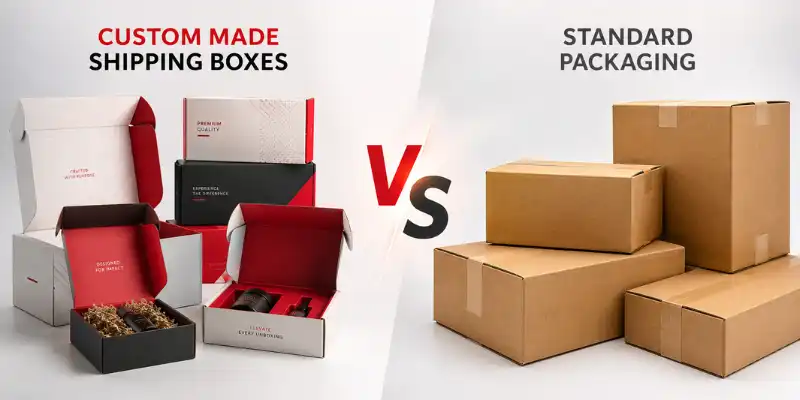
With global eCommerce sales crossing $6 trillion and unboxing videos racking up hundreds of millions of views, the box your product ships in has become a legitimate marketing channel. So the question is: custom made shipping boxes or standard packaging which actually makes more sense for your business?
It depends on your industry, margins, customer expectations, and brand strategy. Let’s break it all down practically and honestly.
What Are Custom Made Shipping Boxes?
Custom made shipping boxes are packaging solutions designed specifically to match a brand’s exact requirements — dimensions, materials, print design, structural style, and finish.
The most common base material is corrugated cardboard, available in:
- Single-wall (B or C-flute): Lightweight products, e-commerce mailers
- Double-wall corrugated: Electronics, fragile or heavier goods
- Triple-wall: Industrial and heavy-duty export shipping
Custom boxes can be printed using flexographic printing (large runs), digital printing (short runs, no plate fees), or offset lithography (premium retail quality). Design options include matte or gloss lamination, soft-touch finishes, interior printing, and structural formats like mailer boxes, tuck-tops, or auto-lock bottoms.
Industries that rely heavily on custom packaging include DTC beauty brands, subscription box companies, consumer electronics, luxury apparel, artisan food producers, and health and wellness brands.
What Is Standard Packaging?
Standard packaging — often called stock or generic packaging — refers to pre-manufactured boxes produced in fixed sizes, available off the shelf with no brand customization.
Common formats include Regular Slotted Containers (RSC) in standard sizes, poly mailers, padded envelopes, and carrier-provided flat-rate boxes. Standard packaging is the default choice for early-stage startups, B2B shippers, industrial logistics, and businesses running temporary campaigns.
Pros: Immediately available, no design lead time, low upfront cost, no minimum order requirements.
Limitations: Zero brand identity, inefficient sizing often inflates dimensional weight shipping charges, poor unboxing experience, and increased void fill usage to compensate for oversized boxes.
Custom Made Shipping Boxes vs Standard Packaging: Head-to-Head Comparison
| Feature | Custom Shipping Boxes | Standard Packaging |
|---|---|---|
| Branding | Full brand identity — logo, colors, messaging | Plain brown or white, no branding |
| Upfront Cost | Higher initial investment | Low upfront cost |
| Per-Unit Cost at Scale | Drops significantly at volume | Doesn’t benefit from brand equity |
| Product Protection | Engineered to product dimensions | Generic fit — increases damage risk |
| Shipping Efficiency | Right-sized = lower DIM weight charges | Oversized boxes inflate freight costs |
| Sustainability | Recyclable materials, less void fill needed | More waste from oversizing |
| Customer Experience | Premium unboxing moment | Functional, forgettable |
| Marketing Impact | Acts as a mobile billboard | None |
| Lead Time | 2–4 weeks | Available immediately |
| MOQ | Typically 50–500 units | None or very low |
Benefits of Custom Shipping Boxes
Stronger Brand Identity
Every custom box that leaves your warehouse is a traveling billboard. When a courier drops a sleek, branded box at a doorstep, it’s seen by neighbors, building mailrooms, and the customer’s social circle. Glossier built enormous brand recognition partly through their iconic pink pouches and branded white boxes — the packaging became part of the identity itself.
The Unboxing Experience Drives Revenue
This is not a soft metric. A Dotcom Distribution study found that 61% of consumers say premium packaging makes them more excited about a product and influences repeat purchases. When a customer opens a custom mailer box with tissue paper, a thank-you card, and a product nestled in a custom insert — that’s an emotional moment that gets linked to your brand and drives loyalty.
Lower Product Damage Rates
A box built to your product’s exact dimensions — with appropriate flute strength and cushioning — dramatically reduces transit damage. Standard boxes often have 30–40% more interior space than needed, meaning the product shifts and absorbs impact during transit. Custom fit means fewer returns, fewer refunds, and lower replacement costs.
Dimensional Weight Savings
Carriers like UPS, FedEx, and USPS charge based on whichever is greater — actual weight or dimensional (DIM) weight. If you’re shipping a 0.5 lb product in an oversized standard box, you might be paying for 2+ lbs. Custom-sized boxes eliminate that wasted space and can reduce shipping costs by 10–25% at scale. For a business shipping 5,000 units per month, that’s a meaningful number.
Eco-Friendly Opportunities
Custom packaging lets you specify recycled content, use unbleached kraft materials, eliminate plastic void fill, and right-size packaging to reduce waste. With 73% of global consumers saying they’d change buying habits to reduce environmental impact (Nielsen), sustainable packaging has become a sales variable — not a nice-to-have.
Higher Perceived Product Value
Premium packaging elevates the perceived value of what’s inside. A luxury candle in a matte-laminated custom box feels more premium than the same candle in a generic brown box. This effect supports higher price points and reduces price sensitivity — directly impacting your margins.
Benefits of Standard Packaging
Standard packaging isn’t the enemy of good business. It’s simply the right tool in specific situations.
Lower upfront investment: When launching a new product and unsure about demand, committing to 500+ custom boxes can be premature. Standard packaging lets you fulfill orders while validating your concept.
Immediate availability: Custom packaging involves design approval and 2–4 week lead times. If you’re running a flash sale or dealing with a supplier shortage, stock packaging gets you shipping today.
Better for industrial and B2B shipping: When shipping machine parts, raw materials, or bulk commodity goods, the recipient cares about what’s inside — not what’s on the box. Over-investing in branding here provides zero ROI.
Simpler for complex multi-SKU inventories: If you carry hundreds of differently-sized products, managing custom box SKUs for each becomes a warehousing challenge. A hybrid approach often works better for large catalogs.
Cost Analysis: Which Option Saves More Money?
This is where businesses most often get it wrong by comparing only the per-unit box price.
The full cost of standard packaging includes:
- Dimensional weight overcharges: $0.25–$1.50+ per shipment
- Void fill materials (bubble wrap, packing peanuts): $0.15–$0.50/unit
- Higher damage rate → returns and replacements: 2–5% of shipments vs 0.5–1.5% with custom-fit boxes
- Zero marketing value from packaging spend
The ROI of custom packaging includes:
- Repeat purchase rates increasing 30–40% among customers who recall a premium unboxing experience
- Shipping cost reduction from right-sizing (often offsets per-unit cost difference within 6–12 months)
- Organic social sharing and user-generated content — measurable through tracked referral codes on inserts
- Reduced return costs from better product protection
For most growing eCommerce businesses shipping 200–300+ units per month, custom packaging begins to make strong financial sense when you account for the complete cost picture — not just what you pay per box.
Sustainable Packaging: Where the Industry Is Heading
Sustainable packaging has moved from niche preference to mainstream expectation.
Kraft and recycled corrugated have become symbols of eco-conscious branding. Molded pulp inserts are replacing styrofoam and plastic foam rapidly. Minimal packaging design — as demonstrated by Apple and Everlane — reduces material use while actually strengthening premium perception.
A 2023 Trivium Packaging survey found that 83% of consumers consider sustainability when purchasing, and 67% would pay more for sustainable packaging. For brands targeting millennial and Gen Z customers, eco-friendly packaging directly influences purchasing decisions.
When to Choose Custom vs Standard: A Practical Guide
Choose custom packaging when:
- You’re building a consumer brand where recognition and loyalty matter
- You ship 200+ units per month consistently
- Your product requires protection beyond what a generic box provides
- Unboxing experience is part of your value proposition
- You want to reduce long-term dimensional weight and damage costs
Choose standard packaging when:
- You’re an early-stage startup validating product-market fit
- You’re shipping B2B, industrial, or commodity goods
- You need to fulfill orders faster than a 2–4 week lead time allows
- You’re running a short-term or temporary campaign
- Your catalog has too many size variations for custom packaging to be practical
Common Packaging Mistakes to Avoid
Wrong box dimensions: Oversizing by even 2–3 inches per dimension adds dollars to every shipment across thousands of orders.
Weak materials for heavy products: Single-wall B-flute and double-wall C-flute may look identical but differ by 30–50% in compression strength. Mismatching flute to product weight leads to crushed boxes.
Ignoring interior packaging: Beautiful exterior design is wasted if the product arrives damaged. Custom inserts and void fill are part of the packaging system — not an afterthought.
Not testing before full rollout: Always test a new packaging design through realistic shipping simulations before committing to a production run. Drop tests and a small batch of real shipments reveal structural issues cheaply.
Over-packaging: Excessive bubble wrap, unnecessary double-boxing, and mountains of packing peanuts are wasteful, expensive, and increasingly off-brand in a sustainability-conscious market.
Packaging That Works as Hard as You Do
Here’s the honest bottom line:
Custom packaging wins for any growing brand where customer experience, brand recognition, and product protection matter. For eCommerce businesses, DTC brands, and subscription companies shipping consistent volume, custom boxes are a competitive necessity — not a luxury. The economics work, the brand impact is real, and the customer experience payoff is measurable.
Standard packaging wins for early-stage startups, B2B shippers, industrial goods, temporary campaigns, and situations where speed and simplicity outweigh brand investment.
The smartest businesses don’t treat this as an either/or decision — they build a packaging strategy that uses custom boxes where the ROI is clear, and stock packaging where simplicity makes more sense.
If you’re ready to take your packaging to the next level, start with a consultation. The right packaging partner won’t just sell you boxes — they’ll help you build a system that protects your products, tells your brand story, and grows with your business.
Frequently Asked Questions (FAQ)
1. Are custom shipping boxes worth it for small businesses?
For small businesses shipping 100+ units per month with a consumer-facing brand, custom boxes are typically worth the investment. The improvement in customer retention, reduction in damage rates, and elimination of dimensional weight overcharges can collectively offset the higher per-unit cost relatively quickly. Start with a small run using digital printing to test the impact before scaling.
2. What is the real difference between custom and standard packaging?
The difference goes beyond aesthetics. Custom packaging is engineered around your specific product dimensions, meaning better protection, lower dimensional shipping costs, and stronger brand recognition. Standard packaging is generic and functional — designed to fit many products approximately, without any branding or optimization.
3. Are custom printed boxes expensive?
Not as expensive as many businesses assume. Digital printing has made custom packaging accessible even at quantities as low as 50–100 units. A simple custom mailer box may cost between $1–$2 per unit depending on size and print complexity. When you factor in lower damage rates, shipping savings, and marketing value, the net cost often becomes far more reasonable.
4. Which packaging is best for eCommerce businesses?
For most eCommerce businesses, a hybrid approach works best. Use custom mailer boxes or branded corrugated shippers for best-selling products and customer-facing shipments, while relying on standard packaging for bulk, industrial, or low-margin items. Matching packaging strategy to product category and customer expectations creates the strongest ROI.
5. Do custom boxes actually improve branding?
Yes — significantly. Custom boxes extend your brand experience into the physical world. Customers are more likely to remember a purchase that arrives in premium packaging, share it on social media, and associate the product with higher quality. For subscription brands and DTC companies, packaging often becomes a defining part of the brand identity.
6. What materials are best for shipping boxes?
Corrugated cardboard remains the industry standard for most shipping applications. Single-wall corrugated works well for lightweight products, while double-wall construction is ideal for heavier or fragile items. Kraft linerboard is popular for eco-friendly branding, while rigid chipboard and SBS paperboard are commonly used for luxury retail packaging.
7. Are custom shipping boxes eco-friendly?
They can be extremely eco-friendly when designed correctly. Most custom corrugated boxes are made with recycled content and are fully recyclable. Brands can also choose unbleached kraft materials, water-based inks, and right-sized packaging structures that reduce waste and eliminate unnecessary void fill materials.
8. How do custom boxes improve customer experience?
Custom packaging creates a memorable first impression. A well-designed box signals professionalism, care, and product value before the customer even opens it. Features like custom inserts, tissue wrapping, premium finishes, and thoughtful presentation create an emotional connection that increases repeat purchase intent.
9. Can small businesses afford custom packaging without huge minimum orders?
Yes. Modern digital printing technology has dramatically reduced minimum order requirements. Many custom packaging suppliers now offer short production runs starting at 50–100 units, making custom boxes accessible even for startups and small businesses testing new products or branding concepts.
10. Which packaging reduces shipping damage the most?
Packaging that is engineered specifically around the product’s weight, dimensions, and fragility profile will always perform best. Custom corrugated boxes with proper flute strength, minimal interior movement, and protective inserts dramatically outperform oversized stock packaging in reducing transit damage.
 Facebook
 Twitter
 LinkedIn
 Pinterest