 Apparel Boxes
 Soap Boxes
 Candle Boxes
 Bakery Boxes
 Cosmetic Boxes
 Cardboard Boxes
 Vape Boxes
 Pillow Boxes
 CBD Boxes
 Cigarette Boxes
 Hair Extension Boxes
 Retail Boxes
 Hemp Boxes
 Display Boxes
 Jewelry Boxes
 Food Boxes
 Die Cut Boxes
 Toy Boxes
 Window Boxes
 Corrugated Boxes
 Kraft Boxes
 Rigid Boxes
 Mailer Boxes
 Mylar Bags
 Gift Boxes
 Seasonal Boxes
 Custom Labels
 Custom Sticker
 Sport Boxes
 Foldable Boxes
 Gable Boxes
 Insert Boxes
 Sleeve Boxes
 Tuck Boxes
 Tin Packaging
 Tube Packaging
 Small Boxes

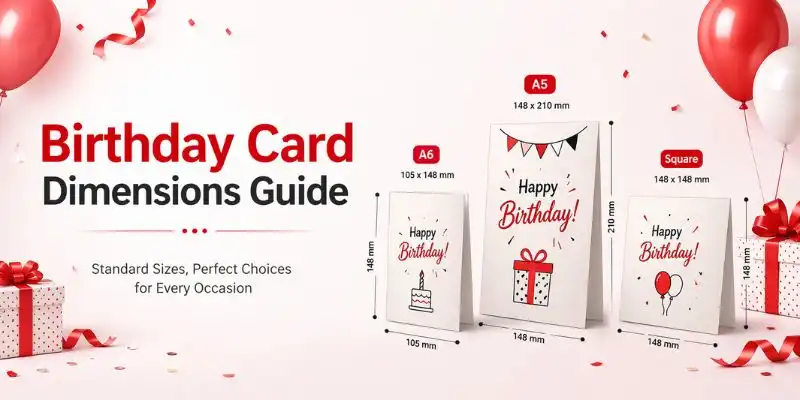
A birthday card might seem like a simple thing — fold a piece of paper, write a message, done. But if you’ve ever tried to design one professionally, print a batch for your stationery business, or hand-craft a card that needs to fit a specific envelope, you already know how quickly “simple” turns complicated.
Get the dimensions wrong, and you’re looking at text that gets cut off at the printer, cards that won’t slide into their envelopes, or designs that look stretched and unprofessional. Get them right, and your card looks polished, prints cleanly, and lands in someone’s hands feeling intentional — like it was made with care.
This guide covers every dimension you need: standard card sizes, envelope pairings, bleed and safe zone rules for printing, digital design specs, and a full breakdown for handmade card makers. Whether you’re a graphic designer preparing print-ready files or a crafter cutting cardstock at home, this is your complete reference.
Why Birthday Card Dimensions Are Worth Getting Right
Before jumping into the numbers, here’s why dimensions deserve more attention than most people give them:
Print Quality Depends on It
Commercial printers crop to exact dimensions. If your artwork extends to the edge of your design but you haven’t added bleed (extra artwork beyond the trim line), the final printed card will have thin white edges where the cut fell. Conversely, if you place important text or logos too close to the edge and the cut lands slightly off — which it always does by a fraction — those elements get clipped.
Envelope Compatibility Is Non-Negotiable
A card that’s 0.5mm too wide won’t slide into its envelope without bending. A card that’s significantly smaller than its envelope rattles around, looks sloppy, and may slide out during mailing. Card and envelope dimensions are a pair — design one without planning for the other and you’ll create problems downstream.
Digital Sharing Requires Different Specs
An e-card or digital birthday card sent via WhatsApp, email, or social media needs completely different dimensions from a printed one. Print uses millimetres and 300 DPI resolution; digital uses pixels and screen resolutions. Mixing up these specs is one of the most common design mistakes beginners make.
Retail and Wholesale Standards Exist for a Reason
If you’re selling cards through shops, markets, or online platforms like Etsy or Notonthehighstreet, buyers expect standard sizes that fit standard envelopes. Unusual sizes can be a delightful differentiator — but only if they’re intentional and communicated clearly.
Understanding Card Orientation
Every card dimension discussion starts with orientation, because the same piece of card can become very different products depending on how it folds.
Landscape (Horizontal) — The card is wider than it is tall. This is the most traditional birthday card format, evoking a classic greeting card feel. When folded, the fold is along the left edge.
Portrait (Vertical) — The card is taller than it is wide. Very popular in contemporary stationery design and particularly common in the UK and European markets.
Square — Equal width and height. A modern, striking format that photographs beautifully for social media and stands out on a card display rack. Requires square envelopes, which are slightly more expensive.
Flat (Single Panel) — Not folded at all. A single printed panel, often used as a postcard-style card or an insert. Common for minimalist designs or when the card will be framed as keepsake art.
Standard Birthday Card Dimensions
Most Common Standard Sizes (Folded Cards)
These are the finished (folded) dimensions — what you actually hold in your hand:
| Card Name | Finished Size (mm) | Finished Size (inches) | Common In |
|---|---|---|---|
| A6 / Quarter A4 | 105 × 148 mm | 4.1 × 5.8 in | UK, Europe, Australia |
| A5 / Half A4 | 148 × 210 mm | 5.8 × 8.3 in | UK, Europe, Australia |
| A2 Greeting Card | 111 × 152 mm | 4.375 × 5.5 in | USA, Canada |
| A7 Card | 73 × 105 mm | 2.875 × 4.375 in | USA (small notecard) |
| 5×7 inches | 127 × 178 mm | 5 × 7 in | USA, worldwide |
| 4×6 inches | 102 × 152 mm | 4 × 6 in | USA, worldwide |
| Square (Small) | 140 × 140 mm | 5.5 × 5.5 in | Worldwide |
| Square (Large) | 155 × 155 mm | 6.1 × 6.1 in | UK, Europe |
| DL Card | 99 × 210 mm | 3.9 × 8.3 in | UK, Europe (tall slim format) |
Flat / Postcard-Style Cards
| Card Name | Size (mm) | Size (inches) |
|---|---|---|
| Standard Postcard | 102 × 152 mm | 4 × 6 in |
| Large Postcard | 127 × 178 mm | 5 × 7 in |
| A6 Flat Card | 105 × 148 mm | 4.1 × 5.8 in |
| Square Flat Card | 140 × 140 mm | 5.5 × 5.5 in |
Flat (Unfolded) Dimensions for Folded Cards
This is where a lot of designers get tripped up. When you’re designing or printing a folded card, you work with the flat (open) dimensions — the full sheet before folding. The fold divides the sheet in half.
| Finished Folded Size | Flat (Open) Size | Fold Direction |
|---|---|---|
| A6 (105 × 148 mm) | 210 × 148 mm | Portrait fold (left edge) |
| A5 (148 × 210 mm) | 296 × 210 mm | Landscape fold (top edge) |
| 5×7 inches | 10 × 7 inches | Portrait fold (left edge) |
| 4×6 inches | 8 × 6 inches | Landscape fold |
| 140 × 140 mm square | 280 × 140 mm | Left edge fold |
| 155 × 155 mm square | 310 × 155 mm | Left edge fold |
Design Tip: When setting up your design file, create the document at flat (open) dimensions. Divide it into two equal panels — front cover and inside — along the fold line. This gives you the complete artwork on one canvas.
Birthday Card and Envelope Size Pairing Guide
This is arguably the most practical section in this entire guide. A card is only as good as the envelope it fits. Here’s a complete pairing reference:
| Card Size (Finished) | Matching Envelope Size | Envelope Code (USA) | Envelope Code (UK/EU) |
|---|---|---|---|
| 105 × 148 mm (A6 card) | 114 × 162 mm | — | C6 envelope |
| 148 × 210 mm (A5 card) | 162 × 229 mm | — | C5 envelope |
| 111 × 152 mm (A2 card) | 4.375 × 5.75 in | A2 envelope | — |
| 127 × 178 mm (5×7 card) | 133 × 184 mm | A7 envelope | — |
| 102 × 152 mm (4×6 card) | 108 × 159 mm | A6 envelope | — |
| 140 × 140 mm square | 150 × 150 mm | — | Square envelope |
| 155 × 155 mm square | 165 × 165 mm | — | Square envelope |
| 99 × 210 mm (DL card) | 110 × 220 mm | — | DL envelope |
The Golden Rule for Envelope Fitting: Your card should be approximately 3–6mm smaller than the envelope in both dimensions. This gives enough clearance to slide the card in and out easily without the card bending, but keeps it snug enough that it doesn’t shift around or fall out.
Print Specifications: Bleed, Safe Zone, and Resolution
If you’re sending your birthday card design to a commercial printer — or even printing at home — understanding these specs will save you from disappointment.
Bleed (3mm Standard)
Bleed is extra artwork that extends beyond the final trim line of your card. It exists because printing and cutting machines aren’t perfectly precise — they’re off by up to 1–2mm. If your background colour or image goes right to the edge of your design but you have no bleed, that tiny cutting variance will leave a thin white strip on one or more edges of your finished card.
Standard bleed: 3mm on all sides
So if your finished card is 105 × 148mm, your design file (with bleed) should be set up at 111 × 154mm.
Safe Zone (also called “Safe Area” or “Live Area”)
The safe zone is the opposite of bleed — it’s a margin kept clear of important content (text, faces, logos, key design elements) inside the trim line. This protects those elements from being clipped if the cut runs slightly inside the trim line.
Standard safe zone: 3–5mm inside the trim line on all sides
So on a 105 × 148mm card, keep all critical content within approximately 99 × 142mm from the card’s center.
Resolution
Print: Minimum 300 DPI (dots per inch) at final size. For fine-detail cards with intricate illustration or photography, 350 DPI is preferable.
Home inkjet printing: 150–300 DPI is usually sufficient depending on your printer.
Digital/screen only: 72–96 DPI is fine for screens, but never use a 72 DPI file for print — it will look blurry and pixelated.
Colour Mode
Print: CMYK (Cyan, Magenta, Yellow, Black). Always design in CMYK when printing. RGB colours look vibrant on screen but shift when converted to CMYK at the printer — reds can go orange, purples can go muddy.
Digital/screen: RGB. Screen displays use RGB, so e-cards and digital designs should stay in RGB.
File Format for Printers
- PDF (print-ready): Most professional printers prefer a press-quality PDF with bleed marks and crop marks included
- TIFF: Acceptable for flat artwork with no transparency
- PNG: Good for digital sharing; not suitable for offset printing
- JPEG: Acceptable for digital; avoid for print due to compression artefacts
Dimensions for Handmade Birthday Cards
If you’re crafting birthday cards by hand — from cardstock, stamping, die-cutting, or mixed media — your approach to dimensions is slightly different from digital design, but the underlying logic is the same.
Standard Cardstock Sizes and What You Can Cut From Them
| Cardstock Sheet Size | Cards You Can Cut From It |
|---|---|
| A4 (210 × 297 mm) | 2× A5 folded cards, or 4× A6 folded cards |
| A3 (297 × 420 mm) | 4× A5 folded cards, or 8× A6 folded cards |
| US Letter (216 × 279 mm) | 2× 5.5 × 8.5 in folded cards |
| 12×12 inch (305 × 305 mm) | 2× square 6×6 folded cards |
Scoring and Folding for Crisp Edges
Always score your fold line before folding — especially on heavier cardstock (200gsm and above). Use a bone folder or scoring tool against a metal ruler. The score should be on the outside of the fold (the side that will face out when folded), running parallel to the shorter dimension for portrait-orientation cards.
Common Handmade Card Sizes
| Style | Cut Size (flat) | Finished Folded Size |
|---|---|---|
| Standard top-fold | 210 × 148 mm (A4 half) | 105 × 148 mm |
| Side-fold card | 148 × 210 mm | 148 × 105 mm |
| Square card | 280 × 140 mm | 140 × 140 mm |
| Slim DL card | 198 × 99 mm | 99 × 99 mm (square) |
| Trifold card | 315 × 105 mm | 105 × 105 mm |
| Z-fold card | 420 × 148 mm | 140 × 148 mm |
Layering and Matting
Handmade cards often use layered panels of decorative paper mounted onto a card base. When planning layers:
- Leave 3–5mm of the card base visible around each layer for a clean stepped border effect
- If your card base is 105 × 148mm, your first layer might be 99 × 142mm, with a second decorative layer at 93 × 136mm
- Keep focal elements (stamped images, die cuts, sentiment strips) at least 10mm from the outer edges of the card
Unusual and Novelty Card Formats
Sometimes a standard rectangle just won’t do. Novelty formats create a memorable first impression and are particularly popular for milestone birthday cards.
Die-Cut Shape Cards — Cut into the shape of a number (like “30” or “50”), a birthday cake, a balloon, or a star. These are printed flat and usually mailed with a backing board for stiffness. No standard dimension applies — work with your die-cut dimensions and order a custom envelope or use a box.
Gatefold Cards — Two front panels open outward like a gate to reveal the inside message. The flat dimensions are three times the finished width. A finished gatefold card of 148 × 105mm requires a flat sheet of 444 × 105mm.
Concertina / Accordion Cards — Multiple panels fold back and forth in a zigzag. When fully extended, they can be displayed as a mini banner. Each panel is usually 100–148mm wide.
Pop-Up Cards — Flat dimensions depend on the complexity of the mechanism, but the card base is typically a standard A5 or A6 size. The pop-up structure is engineered within the interior.
Panoramic Cards — An extra-wide landscape format, typically 200–250mm wide by 100mm tall (finished folded). Makes a dramatic, cinematic impression.
Quick Reference Summary
For Designers and Printers
- Most popular size (UK/EU): A6 folded = 105 × 148mm finished; design at 111 × 154mm with bleed
- Most popular size (USA): 5×7 = 127 × 178mm finished; design at 133 × 184mm with bleed
- Resolution: 300 DPI minimum for print
- Colour mode: CMYK for print, RGB for digital
- Safe zone: Keep critical content 3–5mm inside the trim line
For Card Makers
- A4 sheet → 2 A5 cards or 4 A6 cards
- Always score before folding for clean, professional edges
- Layer panels 3–5mm smaller than each base for stepped border effect
For Digital Cards
- WhatsApp/Instagram: 1080 × 1080px square
- Email: 600 × 400px (landscape) or 600 × 840px (portrait)
- Printable share: 1240 × 1748px at 300 DPI
Final Thoughts
Birthday card dimensions are the invisible infrastructure behind every card that lands perfectly in an envelope, prints without white edges, and feels satisfying to hold. They’re not the glamorous part of card design — but they’re the part that separates cards that look amateur from cards that look like they belong on a shop shelf.
Use this guide as your permanent reference. Bookmark the envelope pairing chart for your next printing project, keep the bleed and safe zone rules front of mind whenever you set up a design file, and remember: whether you’re designing for print, crafting by hand, or creating digital cards to share online, getting the dimensions right from the very start saves time, money, and a lot of frustration at the end.For brands looking to bring precision and consistency into their packaging, BoxesGen offers custom packaging solutions to align with exact product dimensions and presentation goals.
 Facebook
 Twitter
 LinkedIn
 Pinterest